Agentic AI vs Automation: What Enterprise Leaders Need to Know

Automation has been part of enterprise operations for decades. From workflow engines to RPA bots, organizations have invested heavily in automating repetitive tasks to improve efficiency and reduce costs.
Now, a new term is entering boardroom conversations: Agentic AI.
For many CIOs, operations leaders and digital transformation teams the distinction is unclear. Is Agentic AI just automation with better AI? Is it a replacement for RPA? Or is it something fundamentally different?
This article clarifies the difference without hype so enterprise leaders can make informed decisions about when automation is enough, when it breaks down and where Agentic AI fits into modern enterprise workflows.
Why Enterprises Confuse Automation and Agentic AI
The confusion is understandable. Both automation and Agentic AI aim to:
- Reduce manual effort
- Speed up processes
- Improve operational efficiency
- Integrate across enterprise systems
AI Companies often blur the lines by labeling advanced automation, chatbots or AI-assisted workflows as “agents.” As a result many organizations assume Agentic AI is simply the next version of automation.
In reality, automation and Agentic AI solve different classes of problems and misunderstanding this difference leads to poor technology choices and disappointing outcomes.
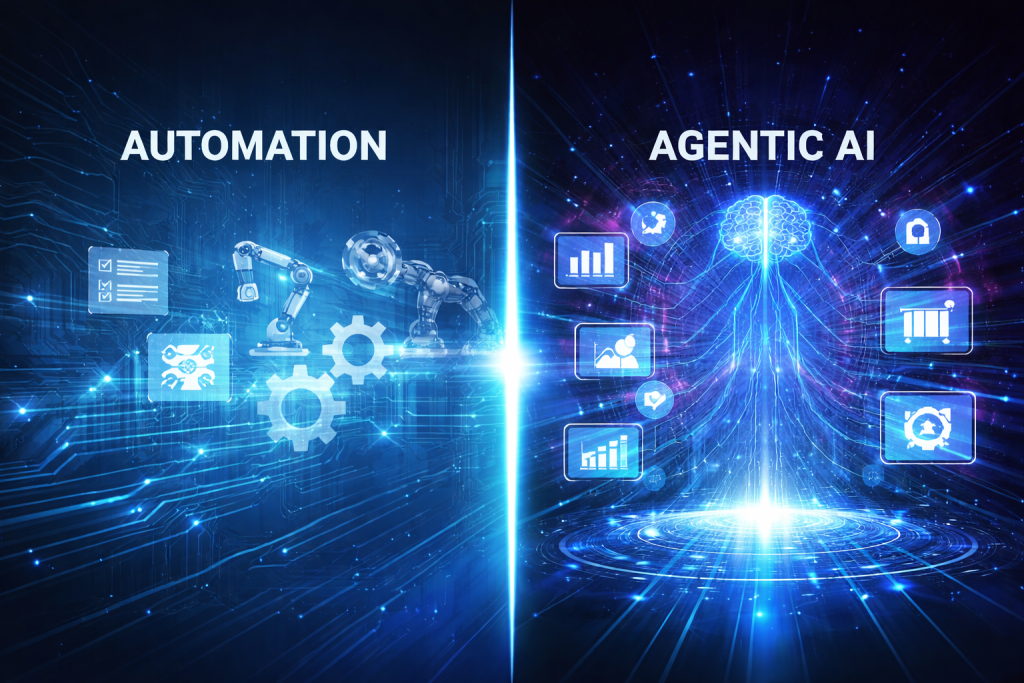
What Traditional Automation Does Well (and Where It Breaks)
Where Automation Excels
Traditional automation including workflow automation and RPA works best when:
- Processes are stable and predictable
- Steps are clearly defined
- Inputs and outputs are structured
- Exceptions are rare
Examples:
- Invoice processing
- Data entry between systems
- Scheduled report generation
- Rule-based approvals
In these scenarios, automation delivers strong ROI and should absolutely remain part of the enterprise stack.
Where Automation Starts to Break Down
Automation struggles when workflows become:
- Dynamic or non-linear
- Dependent on judgment or context
- Prone to frequent exceptions
- Spread across multiple systems with changing states
Common failure points include:
- RPA bots breaking when applications change
- Manual intervention required for edge cases
- Complex workflows requiring constant rule updates
- Limited ability to adapt to new conditions
This is where enterprises start asking for “smarter automation” and where Agentic AI enters the picture.
How Agentic AI Changes Workflow Execution
Agentic AI introduces autonomy and decision making into workflows.
Instead of executing predefined steps, Agentic AI systems:
- Understand a goal
- Decide which actions are required
- Choose tools or systems to interact with
- Adjust behavior based on outcomes
- Escalate to humans when needed
In practical terms, Agentic AI shifts workflows from:
“Follow these steps exactly” to “Achieve this outcome, within defined guardrails.”
This distinction is critical for enterprise environments where work is rarely static.

What Is the Difference Between Agentic AI and Automation?
Agentic AI differs from traditional automation by focusing on goal driven decision making rather than rule-based task execution.
Automation follows predefined steps to complete repetitive tasks, while Agentic AI systems can plan actions, adapt to changing conditions and coordinate across multiple enterprise systems to achieve business outcomes with controlled autonomy.
Automation vs Agentic AI: Side-by-Side Comparison
| Aspect | Traditional Automation | Agentic AI |
| Core model | Rule based execution | Goal driven decision making |
| Flexibility | Low | High |
| Handling exceptions | Manual | Adaptive |
| Autonomy | None | Controlled |
| Context awareness | Limited | Strong |
| Workflow scope | Single process | End-to-end workflows |
| Learning and adaptation | None | Continuous |
| Human involvement | Frequent | Strategic |
This comparison explains why Agentic AI is not a replacement for automation but rather an evolution that addresses automation’s limits.
When Automation Is Enough and When It’s Not
Automation Is Enough When:
- The process is repetitive and stable
- Business rules rarely change
- Errors have low impact
- Speed and consistency matter more than judgment
Examples:
- Payroll processing
- System to system data sync
- Scheduled compliance checks
Agentic AI Is Needed When:
- Workflows span multiple teams and systems
- Exceptions are common
- Decisions depend on context, history or goals
- Human intervention slows operations
- Outcomes matter more than steps
Examples:
- Customer issue resolution
- IT incident response
- Cross functional operational workflows
- Intelligent decision support
Enterprises that try to force automation into these scenarios often end up with brittle systems and growing operational debt.
Enterprise Examples: Automation vs Agentic AI in Action
Customer Support Operations
- Automation: Routes tickets based on keywords.
- Agentic AI: Diagnoses issues, gathers context, triggers workflows across CRM and billing systems, resolves common issues and escalates complex cases with full history.
Impact: Faster resolution and lower support costs.
IT Operations
- Automation: Executes predefined remediation scripts.
- Agentic AI: Detects anomalies, correlates signals across systems, decides corrective actions and adapts responses based on outcomes.
Impact: Reduced downtime and faster incident resolution.
Finance and Operations
- Automation: Processes transactions and approvals.
- Agentic AI: Monitors anomalies, predicts risks, recommends actions and initiates workflows with human oversight.
Impact: Better decision quality and reduced operational friction.
Intelligent Automation vs Agentic AI: Not Either/Or
A common mistake enterprises make is viewing this as a binary choice.
In reality, the strongest architectures combine both:
- Automation handles structured, repetitive tasks
- Agentic AI orchestrates complex, adaptive workflows
- Humans focus on strategy, oversight and exceptions
Agentic AI often sits above automation, coordinating automated tools rather than replacing them.
This layered approach delivers:
- Stability
- Flexibility
- Scalability
- Better ROI over time
How to Combine Automation and Agentic AI Strategically
Enterprise leaders should approach this with a clear strategy:
- Audit existing automated workflows: Identify where automation breaks or requires frequent human intervention.
- Map workflow friction points: Look for delays, handoffs and exceptions.
- Introduce Agentic AI selectively: Start with semi-autonomous agents that assist and recommend actions.
- Define governance and guardrails: Maintain human in the loop control and auditability.
- Scale based on outcomes: Expand autonomy only where trust and value are proven.
This approach minimizes risk while unlocking the real value of Agentic AI.
Why This Distinction Matters for Enterprise Leaders
Agentic AI is gaining momentum because enterprises are reaching the limits of traditional automation. Research shows organizations using AI agents are seeing 30 – 50% improvements in process efficiency, particularly in operations heavy functions.
However, value comes not from replacing automation but from knowing when to augment it with Agentic AI.
The enterprises that get this balance right will move faster, operate more smoothly and scale without linear increases in cost or complexity.
Frequently Asked Questions about Agentic AI and Automation
Is Agentic AI the same as intelligent automation?
No. Intelligent automation enhances rule based automation with AI insights, while Agentic AI introduces autonomous agents that can plan actions, adapt workflows and pursue goals across systems with minimal human intervention.
What Is Agentic AI in Enterprise Environments?
Agentic AI is a class of artificial intelligence systems designed to act as autonomous or semi-autonomous agents that can plan, decide and execute actions to achieve defined business goals.
In enterprise environments, these agents operate within governance controls, integrate with existing systems and collaborate with humans to improve workflow efficiency and decision making.
Will Agentic AI replace RPA and automation tools?
Agentic AI does not replace automation. Instead, it works alongside RPA by orchestrating automated tools, handling exceptions and managing complex workflows where rigid automation falls short.
Is Agentic AI safe for enterprise use?
Yes, when deployed with governance. Enterprises typically use controlled autonomy, human in the loop oversight, audit logs and security policies to ensure Agentic AI systems operate safely and predictably.
What business functions benefit most from Agentic AI?
Agentic AI delivers the highest value in customer support, IT operations, finance workflows, supply chain coordination and enterprise decision support areas where processes are dynamic and exception heavy.
How does Agentic AI improve enterprise workflows?
Agentic AI reduces workflow friction by coordinating tasks across systems, minimizing manual handoffs, adapting to changing conditions and enabling faster, outcome focused execution.
Evaluate Where Agentic AI Fits in Your Workflows
If your organization is exploring Agentic AI, the key question isn’t “Should we replace automation?”
It’s “Where does automation stop delivering value and where do intelligent agents take over?”
To understand the broader picture, learn more about enterprise Agentic AI adoption in our in-depth guide covering use cases, architecture and implementation strategy.
Talk to our AI architects at Futurism AI to evaluate where Agentic AI fits into your workflows and how to combine it effectively with your existing automation stack. With our expertise in intelligent automation, we can help you create a tailored strategy to accelerate your digital transformation.
TRENDING POSTS
-
NLP in 2026: Trends, Challenges, and Real-World Impacts Shaping Global Business
-
How Agentic AI Improves Enterprise Workflows without Replacing Teams
-
Is Agentic AI Safe for Enterprises? Governance, Risk Controls and Real-World Deployment
-
Agentic AI vs Automation: What Enterprise Leaders Need to Know
-
Agentic AI for Enterprises: Use Cases, Architecture and Adoption Strategy