Is Agentic AI Safe for Enterprises? Governance, Risk Controls and Real-World Deployment

Futurism Technologies
February 3, 2026 - 3.2K
5 Min Read
Autonomy makes enterprise leaders cautious and for good reason.
Every major technology shift, from cloud computing to large scale automation, raised the same question before adoption became mainstream: “Is this safe for the enterprise?”
Agentic AI brings that question back into sharp focus. Unlike traditional AI systems that analyze or recommend, Agentic AI can decide and act across systems. That capability creates real business value but it also introduces new considerations around governance, security and accountability.
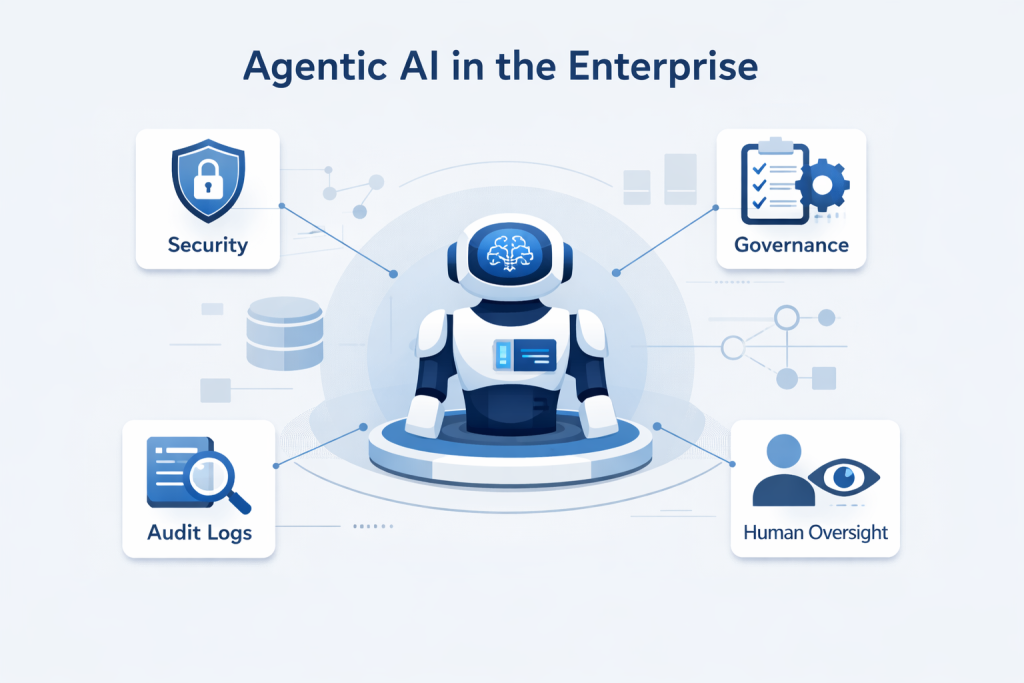
The short answer is yes Agentic AI can be safe for enterprises, when it is designed with controlled autonomy, clear governance and human oversight. Enterprise grade Agentic AI operates within defined policies, enforces role based access, maintains full audit trails and escalates high risk decisions to humans making it suitable for regulated and mission critical environments.
For CIOs, CISOs and CTOs, the real question isn’t whether Agentic AI is impressive. It’s whether it can be deployed predictably, securely and responsibly inside complex enterprise ecosystems.
This article cuts through the hype to explain:
- Why enterprises approach Agentic AI with caution
- What “controlled autonomy” actually means in practice
- The real risks and how they are mitigated
- Governance models that work in production
- How leading enterprises deploy Agentic AI safely, in phases
Why Enterprises Are Cautious About Autonomous AI
Enterprise caution around Agentic AI is not resistance it’s maturity.
Recent enterprise surveys show:
- Nearly 70% of CIOs list governance and security as their top concern when evaluating AI agents.
- Fewer than 20% of enterprises allow fully autonomous AI actions without human oversight.
- Security leaders rank AI-driven decision risk alongside data privacy as a top emerging threat category
These concerns stem from real enterprise realities:
- Regulated data
- Mission critical systems
- Compliance obligations
- Reputational risk
Agentic AI raises valid questions:
- Who is accountable for AI decisions?
- How are actions audited?
- What prevents unintended behavior?
The enterprises that succeed don’t ignore these questions they design for them.
What “Controlled Autonomy” Actually Means in Enterprises
One of the biggest misconceptions is that Agentic AI means “AI operating without limits.”
That is not how enterprises deploy it.
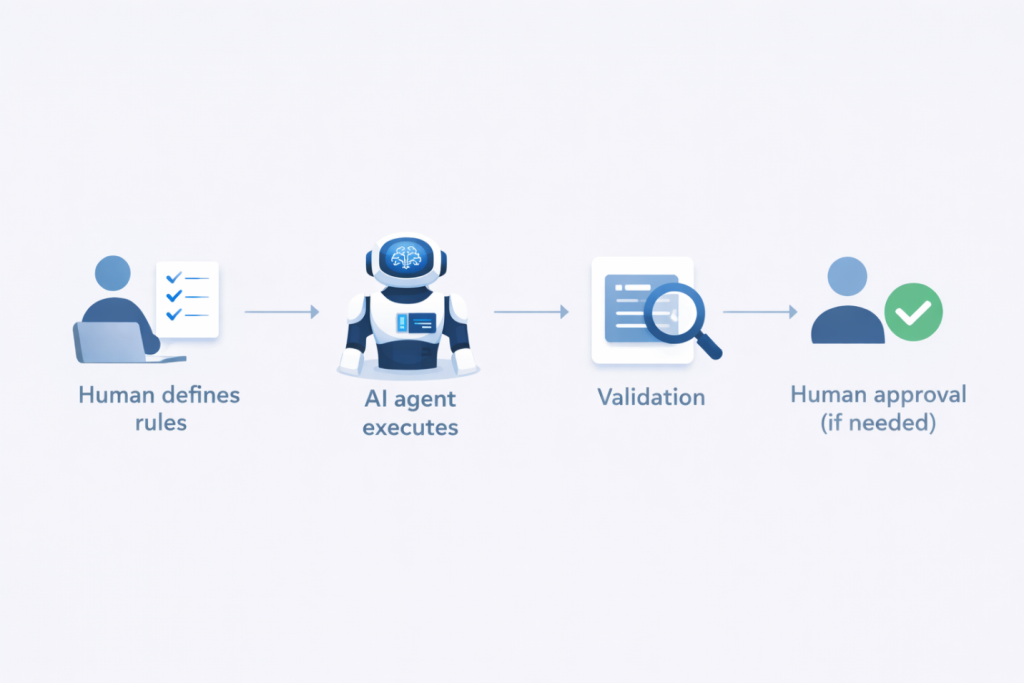
Controlled autonomy means:
- AI agents operate within clearly defined boundaries
- Humans define goals, permissions and escalation paths
- Sensitive actions require approval or validation
- Every decision and action is logged
In practice, Agentic AI behaves more like a trusted junior operator than an unchecked system.
This design principle is why most successful deployments today are semi-autonomous, not fully autonomous.
Common Risks Enterprises Associate with Agentic AI
Understanding risk clearly is the first step toward managing it.
1. Security Risks
Concerns include:
- Unauthorized access to systems
- Misuse of credentials
- Agent actions beyond intended scope
Mitigation: Role based access control, system level permissions and policy enforcement layers.
2. Data Privacy and Leakage
AI agents often interact with sensitive data across systems.
Mitigation: Data minimization, secure connectors, encryption and compliance aligned data handling policies.
3. Hallucinations and Decision Errors
AI systems can produce incorrect outputs or recommendations.
Mitigation: Validation checkpoints, confidence thresholds and human review for high impact actions.
4. Loss of Explain ability
Executives and regulators require clarity into how decisions are made.
Mitigation: Transparent decision logs, traceable reasoning steps and explain ability tooling.
Importantly, Agentic AI systems are designed to expose reasoning and actions, making them more auditable than many black box AI models.
Governance Models That Make Agentic AI Enterprise Ready
Strong governance is what separates experimentation from production grade deployment.
Effective enterprise governance models include:
1. Policy Driven Agent Behavior
Agents operate under policies that define:
- What actions are allowed
- When escalation is required
- Which systems can be accessed
Policies are enforced programmatically not left to interpretation.
2. Centralized Orchestration and Oversight
Instead of independent agents acting in isolation, enterprises use:
- Orchestration layers
- Central monitoring dashboards
- Unified policy enforcement
This ensures consistency and control at scale.
3. Risk Based Autonomy Levels
Not all actions carry equal risk.
Enterprises assign autonomy levels:
- Low risk actions → automated
- Medium risk actions → validated
- High risk actions → human approved
This approach aligns AI behavior with business risk tolerance.
Human in the Loop Design Patterns That Work
Human oversight is not a weakness it’s a strength.
High performing enterprises use human in the loop patterns such as:
- Approval checkpoints for sensitive decisions
- AI generated recommendations reviewed by experts
- Escalation paths for edge cases
- Continuous feedback loops to improve agent behavior
This design ensures AI augments human judgment instead of bypassing it.
Auditability and Compliance: A Non Negotiable Requirement
For regulated industries, safety is inseparable from compliance.
Enterprise ready Agentic AI systems support:
- Complete action logs (what happened, when and why)
- Decision traceability for audits
- Role based accountability
- Alignment with data protection and security standards
This auditability is why many compliance teams are more comfortable with governed AI agents than with ad hoc automation scripts.
How Enterprises Deploy Agentic AI Safely In Phases
Enterprises that succeed follow a deliberate rollout model.
Phase 1: Assistive Agents
Agents observe, analyze and recommend actions no execution.
Phase 2: Semi-Autonomous Execution
Agents execute low risk actions with guardrails and human review.
Phase 3: Controlled Autonomy at Scale
Autonomy expands only after trust, reliability and ROI are proven.
This phased approach dramatically reduces risk while building organizational confidence.
Read Also: Agentic AI and Generative AI: What’s Best for Your Business?
Is Agentic AI Safe for Enterprises? The Real Answer
Yes when it is designed and governed correctly.
In fact many enterprises find that well governed Agentic AI systems are:
- More consistent than manual operations
- More auditable than informal automation
- More secure than fragmented scripts and tools
The risk is not in Agentic AI itself but in deploying it without governance, controls and enterprise grade architecture.
To understand how these systems are structured, see how Agentic AI is architected for enterprises in our detailed enterprise guide.
Frequently Asked Questions about Agentic AI Safety
Can Agentic AI make decisions without human approval?
Yes but only for low risk actions. Enterprises typically require human approval for high impact or sensitive decisions using predefined escalation rules.
Is Agentic AI more risky than traditional automation?
Not necessarily. When properly governed, Agentic AI can be safer than fragmented automation because it includes centralized control, monitoring and auditability.
How do enterprises prevent AI agents from acting incorrectly?
They use validation checkpoints, confidence thresholds, policy enforcement and human in the loop review to prevent incorrect or unintended actions.
Is Agentic AI compliant with enterprise regulations?
Yes, when designed correctly. Enterprise deployments support audit logs, access controls, data governance and compliance with security and regulatory requirements.
Who is accountable for Agentic AI decisions?
Accountability remains with the enterprise. Governance frameworks define ownership, approval authority and escalation paths for all AI driven actions.
Design a Safe, Governed Agentic AI Strategy for Your Enterprise
Every enterprise operates within a unique risk profile, regulatory environment and operational complexity. Deploying Agentic AI safely isn’t about adopting a tool it’s about designing a governance first system from day one.
At Futurism AI, we work with enterprises to design and deploy Agentic AI systems that balance autonomy with control, security and accountability.
We help enterprises:
- Assess Agentic AI risk in real world operating environments
- Design policy driven, auditable AI architectures
- Implement effective human in the loop controls
- Deploy AI agents in phased, enterprise ready rollouts
Talk to our AI experts about building a secure, governed Agentic AI strategy designed for trust, compliance and long term scale.