AI-Powered Supply Chains: The Key to Faster, Smarter, and More Resilient Operations

Did you know that even a small error in forecasting can end up costing companies millions in excess inventory or lost sales?
If you are a supply chain leader, you know today’s operations are more complex than ever global suppliers, shifting demand and constant disruptions make planning a challenge. Yet, many teams are still relying on spreadsheets and manual forecasting which simply can’t keep up.
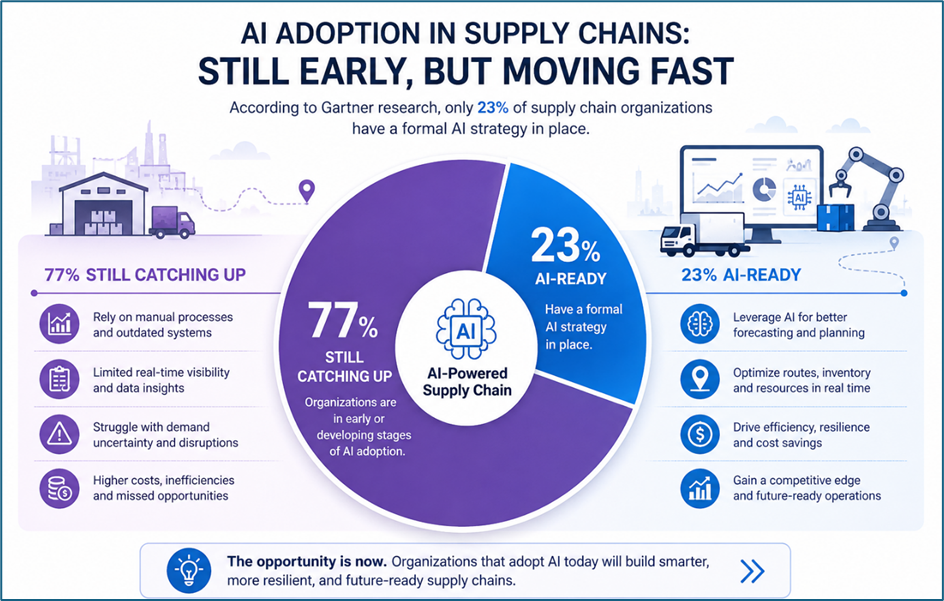
The result is overstocked warehouses, stockouts, and missed opportunities in terms of revenue. In fact, according to Gartner research, only 23% of supply chain organizations today have a formal AI strategy in place, illustrating the early stage at which many organizations are in terms of embracing more intelligent technologies.
This is where AI in supply chain optimization is having a real impact. Through the analysis of large amounts of data, businesses can more accurately predict demand and optimize logistics and inventory management systems.
Why Supply Chains Are Becoming More Complex
Several factors are driving the rapid increase in supply chain complexities:
- Globalized supplier networks
- Volatile consumer demand
- Rising transportation and fuel costs
- Labor shortages and operational disruptions
- Higher expectations for faster delivery
Traditional planning systems were developed for environments in which stability was high. These systems are heavily dependent on historical data and periodic updates, making it difficult for these systems to adapt to dynamic market environments.
AI systems, however, are different in that they are constantly learning from data in real time.
This enables organizations to transition from reactive supply chain management to predictive decision making.
Industry forecasts also show how quickly this shift is happening. Market experts predicts that 70% of large organizations will adopt AI-based supply chain forecasting by 2030, highlighting how rapidly AI is becoming the standard for demand planning.
Core Applications of AI in Supply Chain Optimization
AI can improve nearly every stage of the supply chain. However, three areas stand out as the most impactful for organizations today.
1. Automated Demand Forecasting
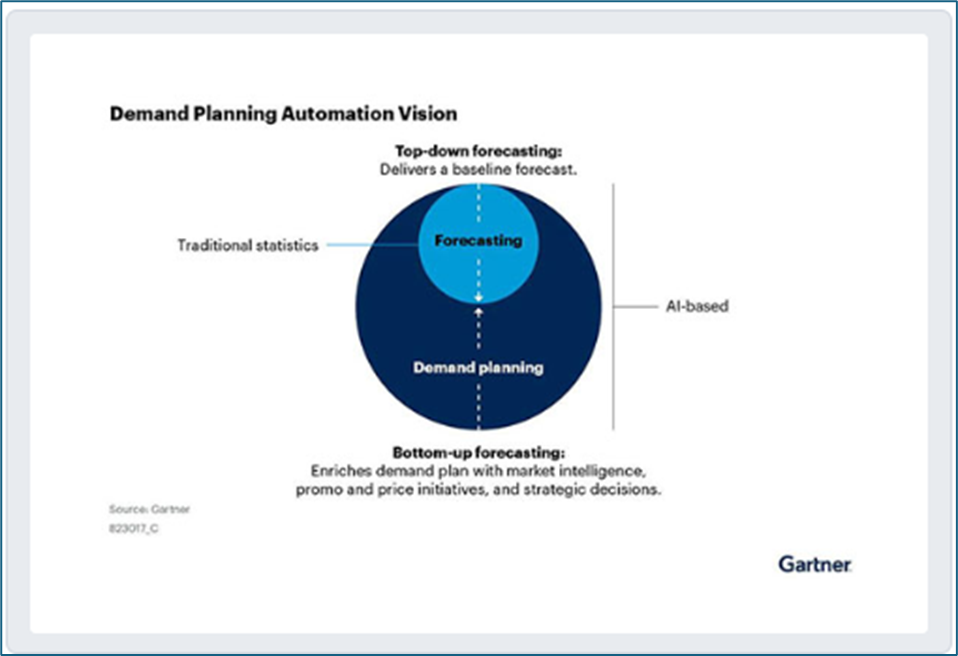
Demand forecasting is one of the most critical and challenging parts of supply chain management.
Even experienced planners struggle to accurately predict demand when faced with factors like seasonal changes, market trends, promotions and economic conditions.
AI transforms forecasting by analyzing multiple data sources simultaneously, such as:
- Historical sales data
- Market trends
- Weather patterns
- Consumer behavior
- Economic signals
Instead of relying solely on past trends, AI models continuously update forecasts as new information becomes available.
Why This Matters:
Better forecasting helps supply chain teams:
- Reduce excess inventory
- Preventing stockouts
- Improve production planning
- Align supply with actual demand
For example, a retail company can leverage AI forecasting to forecast product demand weeks in advance. This will enable the company to adjust production schedules before running out of the product.
The greatest benefit to supply chain leaders is the confidence they have in the decisions they make.
Studies show that organizations using AI-driven forecasting can see demand planning accuracy improve by 20–50%.
2. Intelligent Route Optimization
Transportation is one of the largest cost drivers in supply chain operations.
Delays, inefficient routes and rising fuel costs can significantly impact profitability.
AI-powered route optimization helps companies determine the most efficient way to move goods by analyzing real-time factors such as:
- Traffic conditions
- Weather disruptions
- Fuel costs
- Delivery schedules
- Vehicle capacity
AI systems continuously update routes based on changing conditions, ensuring deliveries stay on schedule while minimizing costs.
The Result:
Organizations benefit from:
- Lower transportation expenses
- Faster delivery times
- Improved fleet utilization
- Reduced carbon emissions
For logistics teams, AI removes much of the manual planning required for routing and scheduling. Instead of spending hours adjusting routes, teams can rely on intelligent systems to optimize operations automatically.
This results in streamlined operations and reduced expenses.
3. Smarter Inventory Management
Inventory management is a delicate balancing act.
Having more inventory than needed ties up money and adds to storage overhead. Not having enough inventory can cause stockouts and lost revenue.
AI improves inventory management by analyzing demand patterns, supplier lead times, and sales trends. It helps determine the optimal stock levels for each product at each location.
Instead of static reorder points, AI systems dynamically adjust inventory strategies based on real-time demand signals.
Key Benefits:
With AI-driven inventory management, companies can:
- Maintain optimal stock levels
- Reduce warehouse holding costs
- Improve product availability
- Respond faster to demand changes
For supply chain managers, this means fewer emergency orders and less guesswork when managing stock levels.
Real-World Example: AI in Retail Supply Chains
Retailers like Walmart and Amazon use AI to revolutionize supply chains by forecasting demand, optimizing inventory and automating logistics to reduce costs and waste. Key examples include Walmart’s AI-driven inventory management (reducing stockouts by 16%), Amazon’s anticipatory shipping and AI-powered route optimization.
Real-World Examples:
- Walmart: Uses AI for hyper-local demand forecasting, saving billions annually and reducing surplus stock by 15%. They also use AI for automated supplier negotiations (achieving 1.5% cost savings) and route optimization to reduce emissions.
- Amazon: Employs “anticipatory shipping” to move products closer to customers before they are ordered. Their warehouses utilize AI-driven robots (Proteus and Sparrow) for faster, safer inventory handling.
- Target: Utilizes AI to optimize store-specific delivery schedules, improving inventory accuracy and reducing stockouts.
- Inditex (Zara): Leverages AI to manage its fast-fashion supply chain, ensuring rapid, efficient design-to-delivery turnarounds.
- Unilever: Created a “digital twin” of its supply chain to simulate, test and respond to potential disruptions.
Primary Benefits of AI in Retail Supply Chains:
- Improved Forecasting: Analyzing sales, weather and trends to predict demand.
- Inventory Efficiency: Reducing stockouts and minimizing wasted inventory.
- Cost Reduction: Automating manual tasks and optimizing transportation routes.
- Sustainability: Reducing unnecessary miles and carbon emissions.
The Business Impact: Benefits and ROI
For many supply chain leaders, the key question is simple:
What is the return on investment?
The benefits of AI in supply chain optimization go beyond operational improvements. They directly impact financial performance and long term resilience.
1. Reduced Operational Costs
AI reduces inefficiencies across procurement, transportation and inventory management.
Companies often see cost reductions through:
- Better route planning
- Reduced fuel consumption
- Optimized warehouse operations
- Improved supplier coordination
Even small improvements across these areas can produce significant savings at scale.
2. Improved Efficiency and Productivity
AI automates many repetitive planning tasks that previously required manual effort.
Supply chain teams can spend less time analyzing spreadsheets and more time focusing on strategic decisions.
This leads to faster decision making and more agile operations.
3. Greater Supply Chain Resilience
The past few years of global disruptions have made it clear how fragile supply chains can be.
AI helps organizations prepare for uncertainty by identifying potential risks early.
Predictive models can alert managers about:
- Supplier delays
- Demand spikes
- Transportation disruptions
With early insights, companies can adjust plans before problems escalate.
Resilience is becoming one of the most important competitive advantages in modern supply chains.
The Future of AI in Supply Chain Optimization
While AI is already transforming supply chains, the next wave of innovation is just beginning.
Emerging technologies such as generative AI and autonomous decision systems are expected to further reshape supply chain management.
In the future, AI-powered systems may be able to:
- Simulate entire supply chain scenarios before decisions are made
- Automatically negotiating supplier contracts
- Predict disruptions weeks in advance
- Coordinate logistics across global networks with minimal human intervention
We are moving toward a world where supply chains become self learning and increasingly autonomous.
For supply chain managers and directors, this shift means embracing AI not just as a tool but as a core strategic capability.
Organizations that adopt intelligent supply chain technologies early will be better positioned to compete in increasingly complex markets.
Thinking about how autonomous AI could fit into your supply chain? Our blog on From Chatbots to AI Agents: The Next Evolution of Enterprise AI dives into the next generation of intelligent systems.
Conclusion:
Supply chains are becoming increasingly dynamic with the rise in complexity, market volatility and operation costs.
It is because of these reasons that the role of AI in supply chain optimization is becoming imperative in the management of the supply chain.
Some of the ways in which organizations can leverage the benefits of AI include:
- Forecast demand more accurately
- Optimize transportation routes
- Manage inventory more efficiently
- Reduce operational costs
- Build resilient supply chain networks
For supply chain managers and directors, the goal is no longer just keeping operations running. The real opportunity lies in building intelligent, data-driven supply chains that can adapt and improve continuously.
Forward thinking companies are already investing in AI-powered solutions to stay ahead of disruption and improve operational performance.
If your organization is exploring how artificial intelligence can transform supply chain operations, Futurism AI can help you understand and adopt the next generation of AI-driven technologies.
The future of supply chain efficiency is already taking shape and AI will play a central role in defining it.
It’s time to explore how AI-driven supply chain optimization can transform your operations and drive real results.
Talk to our AI experts or book a free AI consultation today.
TRENDING POSTS
-
NLP in 2026: Trends, Challenges, and Real-World Impacts Shaping Global Business
-
How Agentic AI Improves Enterprise Workflows without Replacing Teams
-
Is Agentic AI Safe for Enterprises? Governance, Risk Controls and Real-World Deployment
-
Agentic AI vs Automation: What Enterprise Leaders Need to Know
-
Agentic AI for Enterprises: Use Cases, Architecture and Adoption Strategy