AI Demand Forecasting Is Saving Companies Millions – Here’s Exactly How

If your demand forecasts are still sitting in last year’s spreadsheet with a side of gut feeling, the upcoming years are going to hurt.
Markets move faster than your quarterly planning cycle. Customer trends explode overnight. One supply shock, a surprise weather event, or a viral moment can wipe out months of careful inventory planning in days.
The truth? Traditional forecasting is broken for today’s world.
That’s why forward-thinking leaders in retail, manufacturing, and supply chain industries are making AI for demand forecasting a board level priority. It’s no longer a “nice-to-have”, it’s the competitive edge that separates companies that scale profitably from those stuck firefighting stockouts and writing off dead inventory.
In this blog, we break down exactly what AI demand forecasting is, why it crushes old-school methods, and how you can use it to slash costs, reduce lost sales, and build a supply chain that actually anticipates the future.
What is AI Demand Forecasting?
AI demand forecasting uses machine learning models to predict future customer demand by analyzing multiple data streams at once, including historical sales, pricing, promotions, seasonality, weather patterns, market trends, competitor activity, and even social sentiment.
Unlike traditional tools that spit out one static number and call it a day, AI powered demand forecasting tools deliver a range of probable outcomes with clear confidence levels. It doesn’t just say “we’ll sell 5,000 units.” It tells you there’s a 70% chance of selling between 4,200-5,800 units, with upside and downside scenarios.
Think of it like this:
Old forecasting = Weather app saying, “it will rain tomorrow.” AI forecasting = “70% chance of rain, 40% chance of heavy rain, starting around 2 PM.”
That extra clarity completely changes how you plan inventory, staffing, production, and promotions.
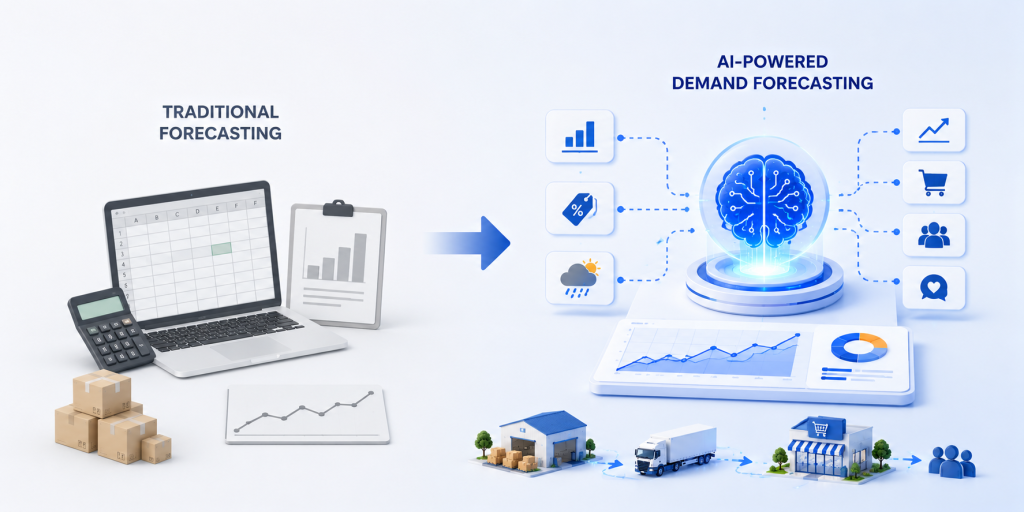
Why Traditional Demand Forecasting Methods Are Failing
Spreadsheets and basic statistical models ARIMA (Autoregressive Integrated Moving Average), moving averages, etc. were built for a slower, more predictable economy. That world no longer exists.
Here’s why legacy methods are quietly costing companies millions:
- They’re blind to real-time signals. Traditional models rely almost entirely on historical sales data. They completely miss critical external factors like viral social trends, sudden weather disruptions, competitor moves, or economic shifts.
- They don’t scale. Managing accurate forecasts across thousands of SKUs, multiple locations, and various sales channels requires massive manual effort, time your teams simply don’t have.
- They give you false confidence. Traditional methods spit out one single number with zero sense of risk or uncertainty. As a result, planners either overstock “just in case” (tying up millions in working capital) or get blindsided by unexpected stockouts and lost revenue.
- They demand constant manual babysitting. In today’s volatile economy, you’re forced to recalibrate forecasts every week. One wrong assumption and your entire plan falls apart.
The result? Bloated inventory eating working capital, missed sales, frustrated customers, and supply chains that are always reacting instead of leading.
How AI For Demand Forecasting Works?
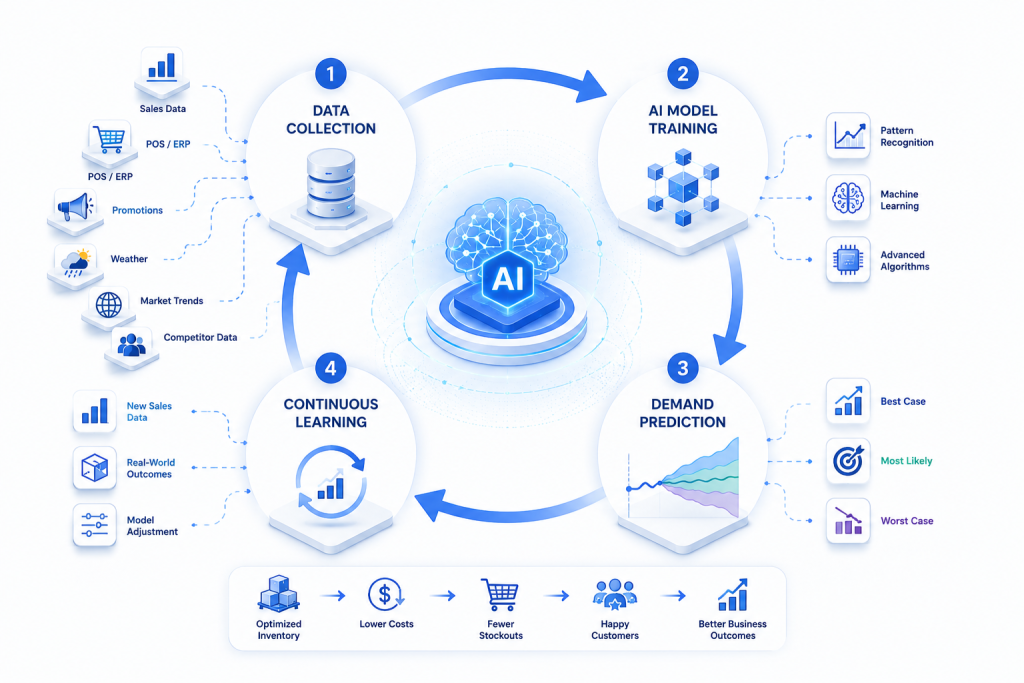
At a high level, AI driven forecasting runs as a continuous loop:
1. Data Ingestion – The system pulls internal data (POS transactions, ERP records, warehouse movement, promotions) and external signals (weather, economic indicators, competitor pricing, search trends).
2. Model Training – Machine learning models, often a blend of gradient boosting and deep learning like LSTM (Long Short-Term Memory), are trained on this combined dataset to identify patterns humans would never spot manually.
3. Probabilistic Forecasting – Instead of one number, the model outputs a range: a “most likely” demand figure plus best-case and worst-case scenarios, helping planners set safety stock intelligently.
4. Continuous Learning – As new sales data comes in, the model retrains itself, automatically adjusting to shifts in consumer behavior, supply disruptions, or new product launches, no manual rebuilds required. This loop is what separates AI demand planning from a one-time forecasting “project.” It’s a living system that gets sharper the longer it runs.
Key Features of AI-Powered Demand Planning Software
Not all tools are created equal. When evaluating solutions, focus on these non-negotiable features:
- Multi-Source Data Integration – Real-time connection to your ERP, CRM, POS, and external feeds. No more siloed data or outdated spreadsheets.
- True SKU-Level Granularity – Forecasts at the individual product, store, location, and channel level, not vague category averages.
- Scenario Simulation (“What-If” Modeling) – Instantly test supply delays, demand spikes, promotions, or market changes before they happen.
- Automated Alerts and Deviation Detection – Get notified the moment actual demand drifts from forecasts so you can fix issues early.
- Seamless ERP and WMS Integration – Forecasts don’t just sit in dashboards, they trigger purchase orders, production schedules, and replenishment runs through advanced AI for Enterprise Resource Planning.
The best AI powered demand forecasting tools don’t just predict better. They drive real operational action.
Benefits of AI-Driven Demand Forecasting
The payoff for enterprises adopting AI for demand forecasting is significant and measurable.
According to McKinsey, organizations implementing AI driven demand forecasting can reduce forecast errors by 20% to 50% compared to traditional methods.
This sharper accuracy leads to:
- Leaner inventory. Better forecasts mean less excess stock tying up cash, and fewer emergency reorders at premium prices.
- Fewer stockouts. Probabilistic forecasting means safety stock is set based on actual risk, not guesswork, keeping shelves stocked without overspending.
- Faster, smarter decisions. Planners spend less time wrangling spreadsheets and more time acting on insights, running scenarios for board-level strategy discussions.
- Stronger supply chain relationships. Sharing clear forecasts with suppliers keeps everyone on the same page and prevents supply chain delays.
Bottom line: better forecasts = lower costs, higher service levels, and more profitable growth.
Discover our AI-driven Business Intelligence solution that turns forecasts into actionable intelligence
AI Demand Forecasting vs Traditional Methods
| Factor | Traditional Forecasting | AI-Powered Demand Forecasting |
| Data sources | Historical sales only | Historical + real-time + external signals |
| Output | Single point estimate | Probabilistic range with confidence levels |
| Granularity | Category or region-level | SKU/location/channel-level |
| Adaptability | Manual recalibration | Continuous, automated retraining |
| New product handling | Weak (cold-start problem) | Strong (transfer learning from similar SKUs) |
| Scalability | Breaks down at scale | Handles millions of SKU-location combos |
| Speed of insight | Days to weeks | Near real-time |
| Best suited for | Stable, slow-moving products | Volatile markets, large catalogs, multi-channel ops |
How Futurism AI’s Demand Forecasting Solutions Help Businesses
At Futurism AI, we don’t just bolt AI onto your existing forecasting process, we rebuild the foundation so your demand planning actually works at enterprise scale.
Our AI Powered Demand Forecasting tools combine your internal sales and operational data with external market signals to deliver SKU-level, probabilistic forecasts your teams can trust and act on. Whether you manage thousands of retail locations, optimize factory production, or lead global supply chains, our AI models are custom-built for your specific business never generic templates.
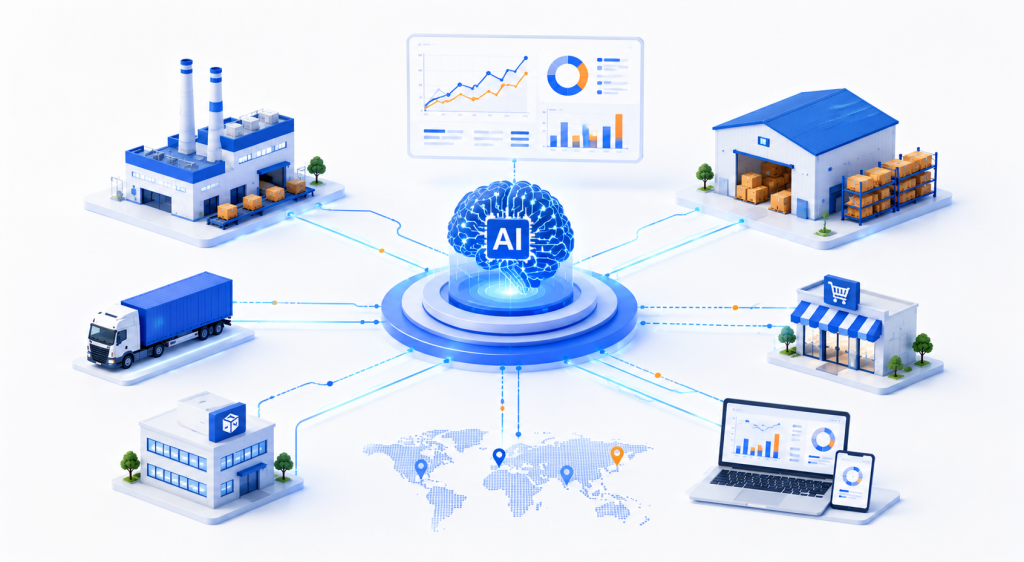
For organizations looking to go deeper into operational integration, our AI in Supply Chain Demand Forecasting solution connects forecast outputs directly to your ERP, WMS, and replenishment systems, turning predictions into automated action fewer manual handoffs, faster response times, and a supply chain that adjusts itself as conditions change.
The Bottom Line
AI for demand forecasting isn’t about replacing your planning team; it’s about giving them superpowers. Enterprises that adopt AI driven forecasting are now making proactive decisions while competitors are still reacting to last quarter’s data.
At Futurism AI, we don’t offer generic solutions. As a custom AI development company, we design, train, and deploy tailored AI forecasting solutions that integrate seamlessly with your existing ERP, WMS, and supply chain systems, delivering superior accuracy, real-time adaptability, and measurable ROI.
Ready to stop reacting and start dominating your market?
Book a free AI Demand Forecasting Assessment with our team today. We’ll analyze your current forecasting gaps and show you exactly how a custom-built solution can slash inventory costs, reduce stockouts, and unlock profitable growth.
Frequently Asked Questions:
What is AI demand forecasting?
AI demand forecasting is the use of machine learning models to predict future customer demand by analyzing historical sales, pricing, promotions, seasonality, and external signals like weather and market trends. Unlike traditional methods, it produces probabilistic forecasts with confidence ranges instead of a single fixed number.
How is AI demand forecasting different and better than traditional forecasting?
Traditional forecasting relies mainly on historical sales data and produces a single point estimate, which struggles with new products, volatile markets, and large catalogs. AI demand forecasting ingests real-time and external data, retrains continuously, and outputs a range of likely outcomes, making it far more accurate at scale.
Which industries benefit most from AI-powered demand forecasting?
Retail, e-commerce, manufacturing, CPG, automotive, and supply chain-heavy businesses benefit the most. These industries deal with high SKU volumes, seasonal swings, and complex multi-location operations where manual forecasting breaks down quickly.
How much more accurate is ai demand forecasting than traditional methods?
AI-driven forecasting models can reduce forecast error significantly compared to statistical baselines like ARIMA (Autoregressive Integrated Moving Average) or moving averages, especially for new product launches, promotional periods, and fast-moving SKUs where historical data alone isn’t enough.
What data is needed to implement AI powered demand planning software?
At minimum, you need 1-3 years of clean historical sales data (POS, ERP, or order history). For best results, this is combined with external signals such as weather data, market trends, competitor pricing, and promotional calendars.
How long does it take to implement AI demand forecasting for an enterprise?
Most enterprise implementations take a few months, starting with a data audit and pilot on a subset of SKUs, followed by integration with ERP/WMS systems, and a phased rollout across the full product catalog. Data quality and integration, not the AI model itself, are usually the biggest factors affecting the timeline.
TRENDING POSTS
-
NLP in 2026: Trends, Challenges, and Real-World Impacts Shaping Global Business
-
How Agentic AI Improves Enterprise Workflows without Replacing Teams
-
Is Agentic AI Safe for Enterprises? Governance, Risk Controls and Real-World Deployment
-
Agentic AI vs Automation: What Enterprise Leaders Need to Know
-
Agentic AI for Enterprises: Use Cases, Architecture and Adoption Strategy