Why Are Enterprises Investing in AI-Powered Voice Assistants?

Are you still losing customers to long hold times or forcing your team to repeat the same answers all day?
Growing enterprises aren’t asking if they should adopt AI-powered voice assistants; they’re asking how fast they can deploy them to stay competitive. These intelligent systems handle thousands of conversations simultaneously, understand context, remember past interactions, and execute real actions like scheduling appointments or updating records.
U.S. enterprises and growing businesses across every industry are implementing AI voice assistants to transform entire workflows. This guide breaks down exactly how they work, the massive ROI they deliver, and how to implement them successfully.
Key Takeaways:
- AI-powered voice assistants go far beyond basic Interactive Voice Response (IVR) systems delivering natural, contextual conversations that handle complex queries, take actions, and integrate with your existing tech stack.
- Businesses using enterprise-grade AI voice assistants report 30-60% reductions in support costs, 40%+ faster response times, and significant gains in agent productivity and customer satisfaction.
- From multilingual support to real-time operations in noisy environments, these tools scale effortlessly across industries while maintaining compliance and security.
- Futurism AI specializes in building custom AI virtual assistants and multilingual AI voice assistants tailored to your business needs, whether for customer service, internal operations, or full agentic workflows.
What Is an AI-Powered Voice Assistant?
An AI-powered voice assistant (also called an AI virtual assistant or AI voice agent) is an intelligent system that engages in natural spoken conversations with customers, employees, or partners. Unlike rigid traditional Interactive Voice Response (IVR) systems that force users through frustrating menus, modern AI assistants understand intent, maintain context across multiple turns, and take meaningful action.
They combine several core AI technologies:
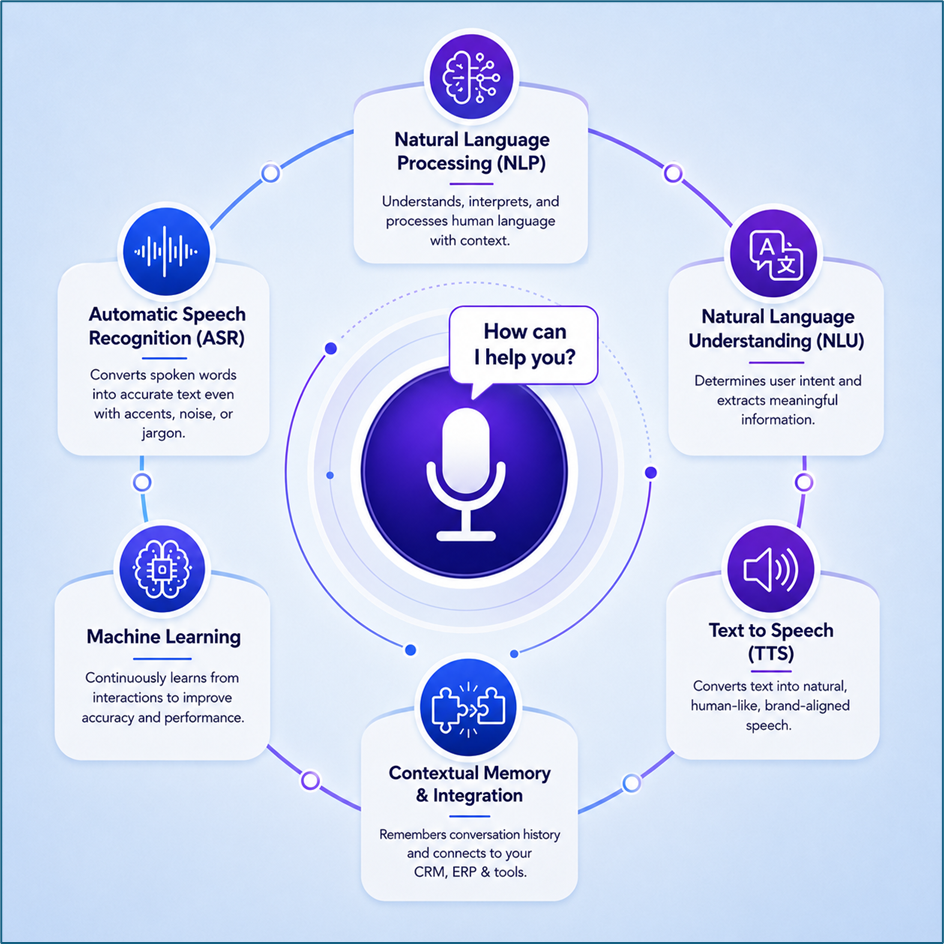
- Automatic Speech Recognition (ASR): Converts speech to text accurately, even with accents, background noise, or domain-specific jargon.
- Natural Language Understanding (NLU): Interprets meaning, not just words.
- Dialogue Management and Contextual Memory: Remembers conversation history and business context.
- Text-to-Speech (TTS): Delivers natural-sounding, brand-aligned voice responses.
The result? A scalable AI personal assistant for business that feels human but operates 24/7 without fatigue.
How AI-Powered Voice Assistants Work (Step-by-Step)
Building or deploying a robust AI voice assistant involves a seamless pipeline:
- Speech Input and Automatic Speech Recognition (ASR): The user speaks. High-accuracy ASR (often powered by models like Whisper or custom-tuned engines) transcribes it in real time, handling noise, accents, and speed variations.
- Natural Language Understanding (NLU): The system analyzes intent, extracts entities (e.g., dates, product names, account details), and considers conversation history.
- Reasoning & Action: Using large language models and business logic, the assistant decides the best response or action. This might involve querying your CRM, checking inventory, or triggering a workflow.
- Text-to-Speech (TTS) Output: A natural voice responds instantly. Advanced systems adjust tone for empathy, urgency, or professionalism.
- Continuous Learning: Machine learning improves performance over time with real interaction data, making the assistant smarter and more accurate.
Multilingual AI voice assistants extend this pipeline with seamless language switching and cultural nuance awareness, critical for global or diverse U.S. customer bases.
Key Features of Enterprise-Grade AI Voice Assistants
Not all voice tools are created equally. Look for these capabilities when evaluating solutions:
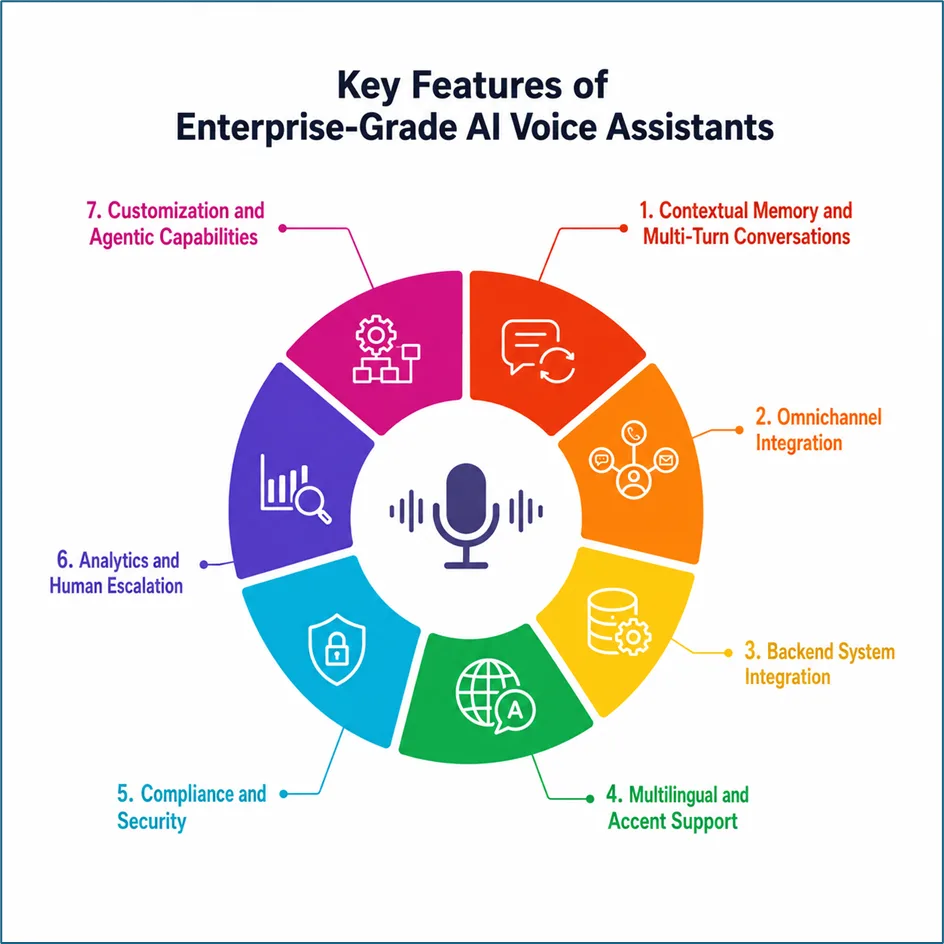
- Contextual Memory and Multi-Turn Conversations:
Remember details across long interactions and channels.
- Omnichannel Integration:
Voice + chat + messaging with consistent context.
- Backend System Integration:
Connects to CRMs, ERPs, ticketing systems, and databases for real actions.
- Multilingual and Accent Support:
Handles 100+ languages and regional variations.
- Compliance and Security:
GDPR, HIPAA, SOC 2 readiness with data masking and audit trails.
- Analytics and Human Escalation:
Detailed insights plus smooth handoffs to live agents.
- Customization and Agentic Capabilities:
Tailored to your industry jargon and able to execute complex multi-step processes. Enterprise-grade AI voice assistants rely heavily on sophisticated NLP models for intent recognition and contextual understanding.
For a deeper dive into the latest developments, read our guide, NLP: Trends, Challenges, and Real-World Impacts Shaping Global Business.
Real Business Benefits and ROI
The numbers are compelling:
- Cost Reduction: 30-60% lower support costs by automating 60-80% of routine interactions.
- Efficiency Gains: Agents handle more complex issues; average handle time drops significantly.
- Scalability: Handle peak volumes without hiring surges.
- Productivity Boost: Employees in operations, field service, and sales reclaim hours previously lost to manual data entry.
- Customer Satisfaction: Faster responses (often instant) and personalized interactions lead to higher CSAT and retention.
- Revenue Impact: Faster lead qualification and appointment booking convert more prospects.
AI-Powered Voice Assistants vs. Traditional IVR/Chatbots
| Feature | Traditional IVR | Basic Chatbots | Enterprise AI Voice Assistants |
| Conversation Style | Rigid menus | Scripted text | Natural, contextual dialogue |
| Context Retention | None | Limited | Full conversation + history |
| Action-Taking | Very limited | Basic | Complex workflows & integrations |
| Scalability | Good | Moderate | Massive (thousands simultaneously) |
| Multilingual Support | Poor | Variable | Excellent |
| Learning & Improvement | Static | Limited | Continuous ML |
| User Experience | Frustrating | Okay | Human-like & delightful |
AI voice assistants win decisively for modern businesses seeking real transformation.
Industry-Specific Use Cases
- Customer Service and Support: 24/7 query handling, troubleshooting, billing issues, and personalized recommendations.
- Sales and Lead Qualification: Instant response to inbound calls, qualification, and appointment scheduling.
- Operations and Field Service: Hands-free data capture, inventory checks, maintenance logging, and safety reporting, especially valuable in noisy or mobile environments (automotive, aviation, warehousing, energy).
- Healthcare and Finance: Secure, compliant interactions for appointment booking, claims support, and regulatory documentation.
- Internal Productivity: AI personal assistant for business use cases like HR queries, IT support, meeting transcription, and workflow automation.
Implementation: Best Practices and Common Challenges
Best Practices:
- Start with high-volume and repetitive use cases for quick wins.
- Prioritize seamless integrations with your core systems.
- Design conversations for voice (short, clear, empathetic).
- Plan human escalation paths and monitor performance obsessively.
- Choose a partner that offers custom development and ongoing optimization.
Common Challenges and Solutions:
- Latency → Use optimized real-time pipelines.
- Accuracy in Noisy/Accented Speech → Custom ASR training.
- Data Privacy → On-prem or secure cloud options.
- Adoption → Change management and clear ROI tracking.
Ready to Transform Your Business with AI-Powered Voice Assistance?
Whether you want to supercharge customer service, streamline operations, or boost internal productivity, the right implementation delivers measurable ROI fast.
At Futurism AI, we don’t sell generic tools. We build and deploy custom, enterprise-grade AI voice assistants tailored to your industry, processes, and goals, complete with speech recognition, NLP, multilingual capabilities, and deep integrations.
What’s one process in your business that is being slowed down by repetitive conversations? Let’s fix it with intelligent voice AI.
Visit our website to learn more, or reach out today for a personalized consultation.
Frequently Asked Questions:
1. What is the difference between an AI-powered voice assistant and a traditional IVR?
Traditional IVR uses fixed menus and button presses. AI-powered voice assistants understand natural speech, maintain context, and perform complex actions intelligently.
2. Can multilingual AI voice assistants handle different accents effectively?
Yes. Enterprise solutions from Futurism AI are trained on diverse datasets and continuously improve, delivering high accuracy across languages and accents common in the U.S. workforce and customer base.
3. Will AI voice assistants replace human agents?
No. They handle routine tasks exceptionally well, freeing humans for high value, complex, or empathetic interactions. The best results come from human-AI collaboration.
4. How do I build or get started with a custom AI voice assistant for my business?
Partner with experts. Contact Futurism AI to assess your needs, prototype quickly, and deploy production ready AI virtual assistants that integrate with your existing tools.
TRENDING POSTS
-
NLP in 2026: Trends, Challenges, and Real-World Impacts Shaping Global Business
-
How Agentic AI Improves Enterprise Workflows without Replacing Teams
-
Is Agentic AI Safe for Enterprises? Governance, Risk Controls and Real-World Deployment
-
Agentic AI vs Automation: What Enterprise Leaders Need to Know
-
Agentic AI for Enterprises: Use Cases, Architecture and Adoption Strategy