Bank of America’s $1.2B AML Penalty: How AI Can Find the Blind Spots?

Your AML system generates alerts. Your rules are running. Your team investigates flagged transactions. But what happens when suspicious activity never triggers an alert in the first place?
That is the question financial institutions should be asking after the October 2026 enforcement action involving Bank of America.
On October 13, 2026, the Financial Crimes Enforcement Network (FinCEN) assessed a $1.2 billion civil money penalty against the bank. Its consent order detailed significant deficiencies in transaction monitoring and the bank’s broader anti-money laundering program.
According to FinCEN, more than $5 billion in suspicious activity was subject to missed or delayed detection and reporting. A subsequent lookback identified nearly 8,900 suspicious activity reports (SARs) that had not been identified and filed under revised monitoring parameters. The lesson extends beyond one financial institution. Having a transaction monitoring system is not the same as having one that consistently detects the risks that matter.
The AML Blind Spot: When Yesterday’s Rules Meet Today’s Risks
Rules-based monitoring remains essential. It can identify known patterns, enforce defined conditions and help financial institutions investigate potentially suspicious activity. The problem arises when thresholds, risk weights and detection rules fail to keep pace with changing behavior.
FinCEN’s order states that 76% of Bank of America’s risk-factor weights remained unchanged from 2018 to 2023. The order also describes weaknesses in monitoring, testing and the timely resolution of identified issues.
For other financial institutions, this raises an important question: Could your monitoring rules be overlooking suspicious activity simply because it doesn’t match the patterns your systems were designed to catch?
A series of transactions might appear ordinary when assessed individually but raise concerns when evaluated together. Poorly calibrated thresholds can leave meaningful signals below the point at which investigators are alerted.
And when risk assumptions go unchallenged, those blind spots can persist.
How AI Can Strengthen AML Transaction Monitoring
If properly implemented AI can help financial institutions analyze transaction patterns, prioritize investigations and assess whether existing detection methods are missing important signals.
1. Detect Patterns Traditional Rules May Miss
AI-driven anomaly detection can identify unusual combinations of transaction frequency, amounts, counterparties and customer behavior.
For example, individually low-risk transactions might reveal a different pattern when analyzed across time or alongside related activity. AI can help surface those patterns for further investigation.
An anomaly is not proof of money laundering. The goal is to give investigators additional signals to assess, rather than automatically treating unusual activity as suspicious.
2. Challenge Thresholds Before They Become Costly Blind Spots
Investigation thresholds determine which transactions receive attention. If they are poorly calibrated, potentially significant activity may never reach an investigator.
AI-powered analytics can help institutions examine historical cases, sample transactions below existing thresholds and compare model scores against investigation outcomes.
These insights can help teams identify where thresholds or risk scores may need adjustment. Proposed changes should be tested against real institutional data before they influence live monitoring.
3. Connect Transaction Activity with Customer Context
A transaction rarely tells the full story. Customer due diligence records, beneficial ownership information, counterparties and previous investigations may all help establish whether a transaction warrants closer examination.
AI-powered knowledge graphs and enterprise search can help connect relevant information across different data sources, making it easier for investigators to uncover relationships and assemble case context.
4. Turn Alerts into More Focused Investigations
Generating an alert is only the beginning. Investigators still need to gather evidence, understand transaction histories and document their findings.
AI-supported workflows can help summarize relevant records, assemble transaction timelines and surface related activity. This can reduce repetitive information gathering and allow analysts to concentrate on substantive investigations. AI-generated outputs still require verification. Decisions about suspicious activity reporting must follow applicable requirements and established review procedures.
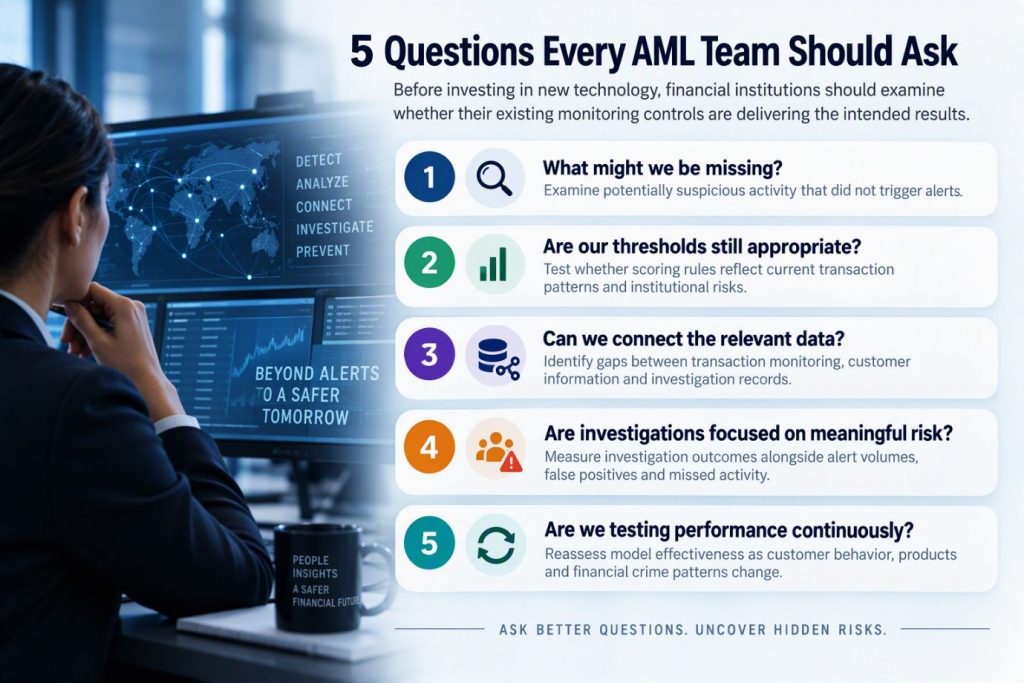
Better Risk Detection Starts with Better Questions
The Bank of America enforcement action is a stark reminder that monitoring systems can have serious weaknesses even when controls are operating. Financial institutions do not need more alerts for the sake of generating more alerts. They need stronger ways to identify relevant risk, investigate meaningful patterns and determine where their current methods may fall short.
Our AI in Fraud Risk Modeling solution offers a starting point for exploring anomaly detection, predictive risk scoring and transaction analytics tailored to financial services use cases.
Don’t wait for a costly finding to expose a monitoring blind spot.
Speak with Our AI Specialists to explore how AI-powered fraud risk modeling could support your financial crime monitoring priorities.
TRENDING POSTS
-
NLP in 2026: Trends, Challenges, and Real-World Impacts Shaping Global Business
-
How Agentic AI Improves Enterprise Workflows without Replacing Teams
-
Is Agentic AI Safe for Enterprises? Governance, Risk Controls and Real-World Deployment
-
Agentic AI vs Automation: What Enterprise Leaders Need to Know
-
Agentic AI for Enterprises: Use Cases, Architecture and Adoption Strategy