Why Businesses Are Investing in AI Agents and Intelligent Automation Solutions

Businesses generate more data than ever, but data alone does not drive growth. The real challenge is turning information into timely decisions and coordinated action. Many organizations still rely on manual processes, disconnected systems, and fragmented workflows that slow execution and limit productivity.
This is one reason AI agents are gaining traction across industries. With 57% of organizations already using AI agents for multi-stage workflows and 80% reporting measurable returns, businesses are increasingly viewing AI-powered automation as a strategic investment rather than an experimental technology. (Resource: Anthropic)
Here’s why organizations are investing in AI agents and intelligent automation solutions.
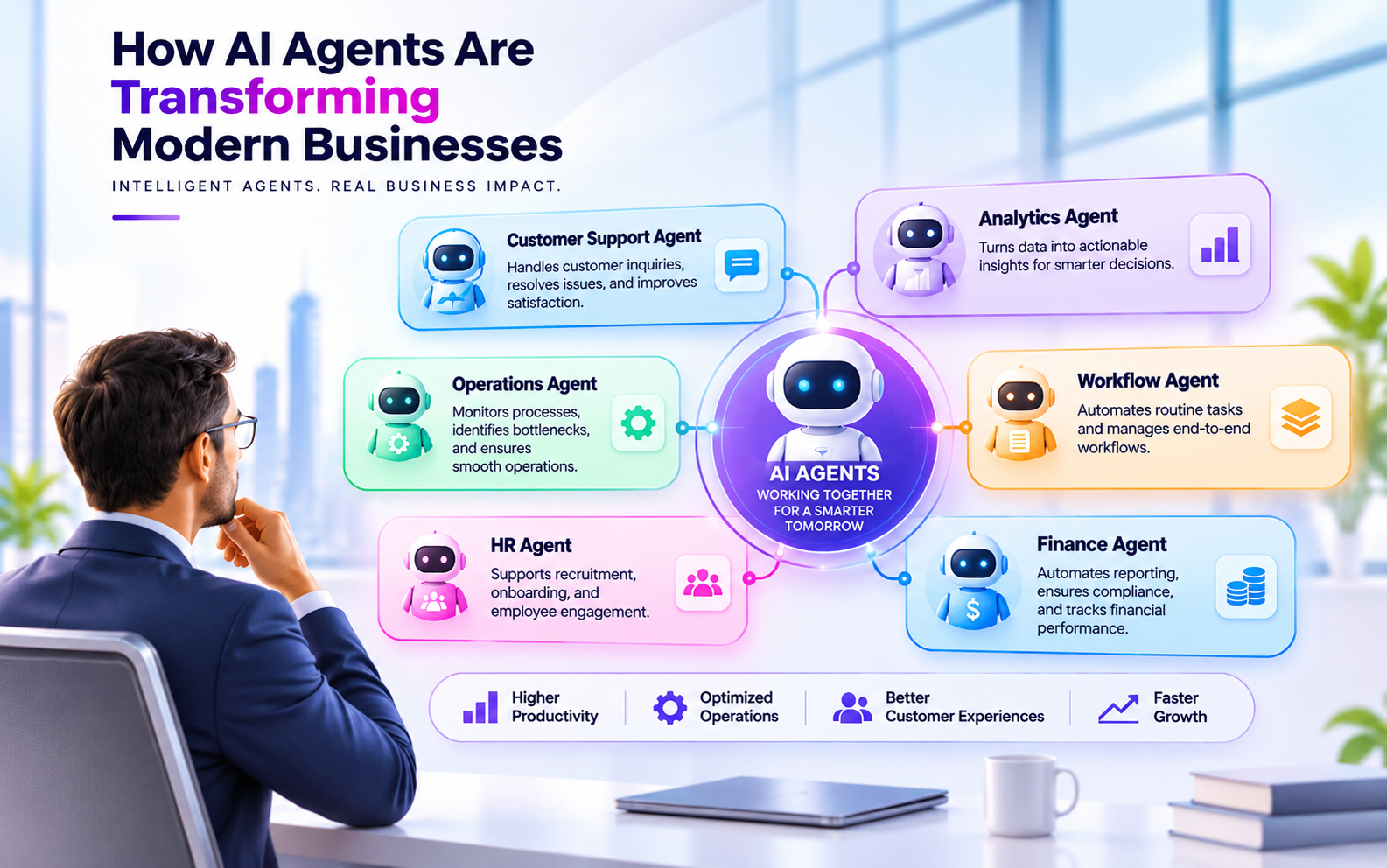
What Are AI Agents and Intelligent Automation Solutions?
Traditional automation follows predefined rules and workflows. AI agents, however, can perceive information, analyze situations, make decisions, and perform complex tasks with minimal human intervention.
Modern AI agent solutions combine technologies such as:
- Machine Learning (ML)
- Natural Language Processing (NLP)
- Generative AI
- Predictive Analytics
- Workflow Automation
- Multi-Agent Systems
These technologies work together to automate not only repetitive tasks but also knowledge-based processes that previously required human involvement. Instead of asking; “How can we automate this task?”
Businesses can now ask:
- How can we automate entire workflows?
- How can we improve customer interactions at scale?
- Which processes should be optimized first?
- How can AI agents support employee productivity?
- Where can we achieve the highest operational savings?
Modern AI agent platforms create intelligent ecosystems that connect people, processes, and systems to deliver measurable business outcomes.
Why Businesses Are Prioritizing Intelligent Automation
Businesses are moving beyond isolated automation projects and investing in technologies that can improve decision-making, efficiency, and scalability across entire operations. AI agents and intelligent automation solutions help organizations connect data, workflows, and business systems, enabling them to respond faster, reduce operational friction, and support growth without proportionally increasing costs.
AI automation platforms can help with:
- Customer service automation
- Sales process optimization
- Knowledge management
- Workflow orchestration
- Employee productivity enhancement
When intelligent automation and AI agents work together, businesses improve efficiency, reduce costs, and accelerate innovation. Rather than replacing human expertise, AI empowers employees to focus on strategic work, creative problem-solving, and business growth.
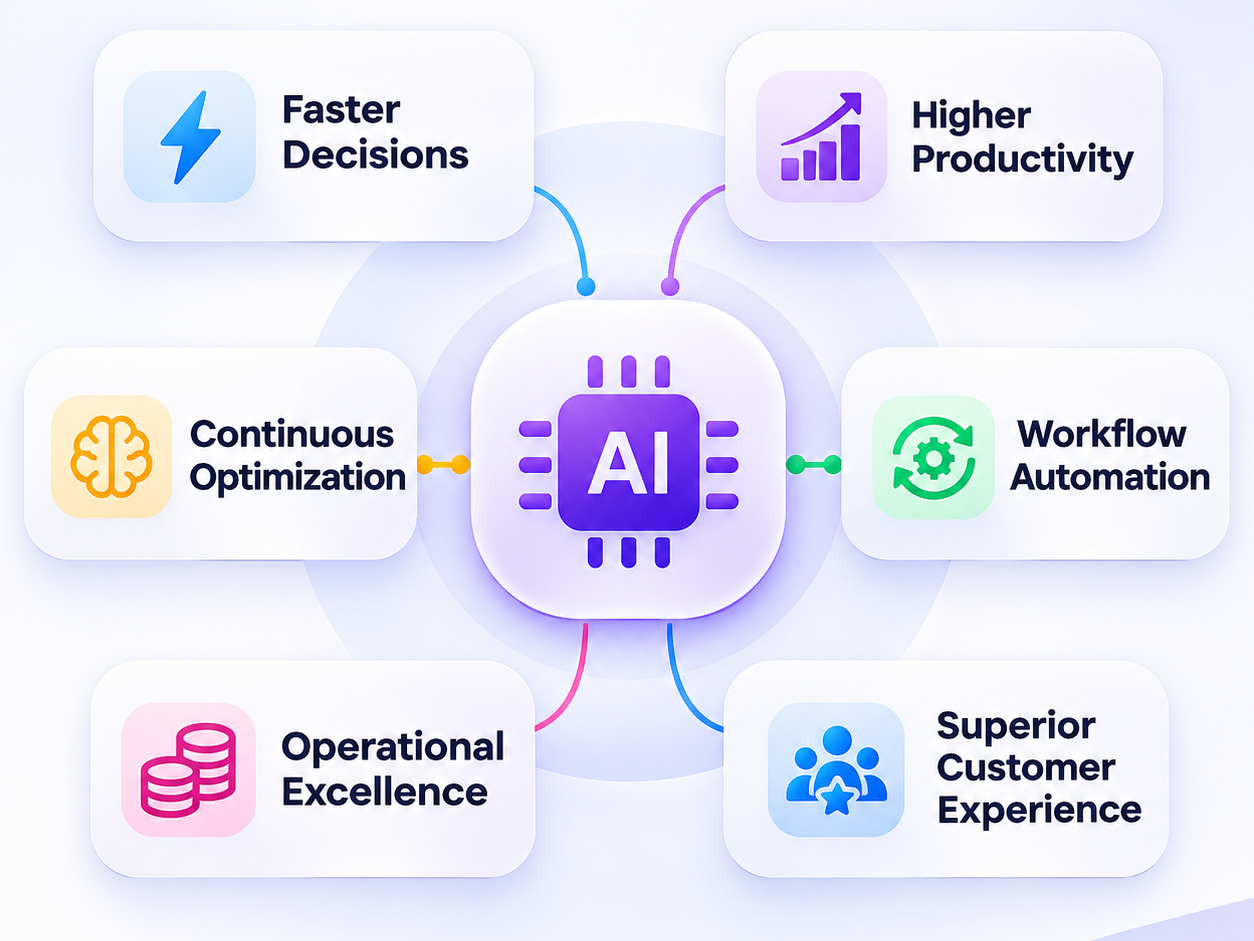
6 Key Benefits of AI Agents for Modern Businesses
Organizations are investing in AI agents because they can automate decisions and actions, not just routine tasks. Unlike conventional automation tools that follow predefined rules, AI agents can adapt to changing conditions, coordinate across systems, and support outcomes that directly impact revenue, efficiency, and customer experience.
1. Faster Decision-Making
AI agents analyze information in real time and provide actionable recommendations, helping organizations respond quickly to changing business conditions and make more confident decisions.
2. Increased Productivity
By automating repetitive tasks and routine workflows, AI agents free employees to focus on strategic initiatives, innovation, and higher-value work.
3. Intelligent Process Automation
AI agents can manage complex, multi-step workflows with minimal human intervention, improving efficiency, scalability, and operational consistency.
4. Enhanced Customer Experience
By understanding customer interactions and behavior patterns, AI agents enable more personalized experiences, faster support, and stronger customer relationships.
For example, a customer service team can use AI agents to classify inquiries, retrieve information from internal systems, draft responses, and resolve common requests automatically. This reduces response times while allowing human agents to focus on complex customer issues.
5. Operational Efficiency
AI continuously identifies bottlenecks, optimizes resource allocation, and streamlines processes, helping businesses reduce costs while improving performance.
6. Continuous Learning and Improvement
Unlike traditional software, AI agents learn from data and interactions over time, enabling ongoing optimization and better business outcomes.
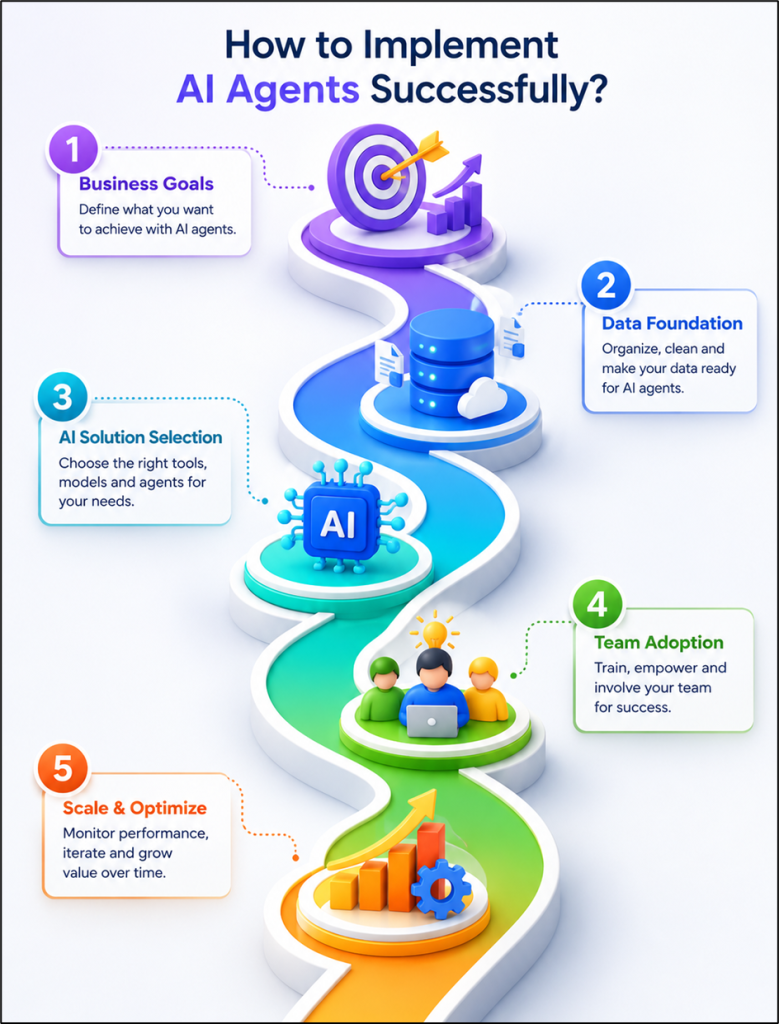
How to Implement AI Agents Successfully?
Many organizations fail to maximize AI investments because they adopt technology without a clear strategy. Successful implementation requires aligning AI initiatives with business goals, building a strong data foundation, and focusing on measurable outcomes.
Define Clear Business Objectives
Start by identifying the specific challenges you want AI agents to solve. Whether the goal is improving customer service, reducing operational costs, or increasing productivity, clear objectives provide direction and make it easier to measure success.
Build a Strong Data Foundation
AI agents are only as effective as the data they can access. Ensuring data quality, governance, security, and seamless system integration helps improve performance and reliability while supporting compliance requirements.
Choose the Right Solutions
Select AI technologies that address your organization’s unique needs and workflows. The most successful implementations focus on solving real business problems rather than adopting AI for the sake of innovation.
Prepare Teams for Adoption
Employees play a critical role in AI success. Providing training and establishing clear guidelines helps teams use AI effectively, build trust in its outputs, and maximize the value of automation.
Measure and Scale
Start with a high-impact use case rather than attempting a company-wide rollout. Many successful organizations begin with customer support, internal knowledge management, or workflow automation before expanding AI agents into other business functions.
The Role of AI Agents in Business Strategy
Organizations are increasingly shifting from reactive operations to proactive decision-making. AI agents help leaders analyze information, execute workflows, and support strategic initiatives more effectively.
AI agents support long-term business strategy by helping organizations:
- Process optimization
- Customer engagement
- Workforce augmentation
- Risk identification
- Opportunity discovery
Rather than replacing employees, AI empowers teams to work more efficiently and make better decisions. As a result, businesses become more agile, innovative, and competitive in rapidly changing markets.
Also Read: Your Enterprise Doesn’t Need 1,000 AI Assistants. It Needs Specialist AI Agents.
Future of AI Agents and Intelligent Automation
AI-powered automation is evolving rapidly and creating new opportunities for businesses worldwide. Emerging trends include:
- Autonomous AI Agents: Agents capable of independently managing complex business workflows.
- Multi-Agent Systems: Collaborative AI agents working together to solve business challenges.
- Agentic Customer Support: AI-driven service experiences that resolve issues end-to-end.
- AI Workforce Augmentation: Human employees working alongside intelligent digital assistants.
- Real-Time Decision Intelligence: Faster and more accurate operational decision-making.
- Enterprise AI Platforms: Unified environments for building, deploying, and managing AI agents at scale.
These innovations will make AI solutions more powerful, accessible, and valuable across industries.
Conclusion
AI agents are becoming a strategic investment for businesses looking to improve efficiency, accelerate decision-making, and scale operations. The greatest value comes from aligning AI initiatives with clear business objectives and measurable outcomes.
Futurism AI helps organizations design, deploy, and scale AI agent solutions that deliver real business impact. Schedule a free consultation to identify the best opportunities for your organization.
TRENDING POSTS
-
NLP in 2026: Trends, Challenges, and Real-World Impacts Shaping Global Business
-
How Agentic AI Improves Enterprise Workflows without Replacing Teams
-
Is Agentic AI Safe for Enterprises? Governance, Risk Controls and Real-World Deployment
-
Agentic AI vs Automation: What Enterprise Leaders Need to Know
-
Agentic AI for Enterprises: Use Cases, Architecture and Adoption Strategy