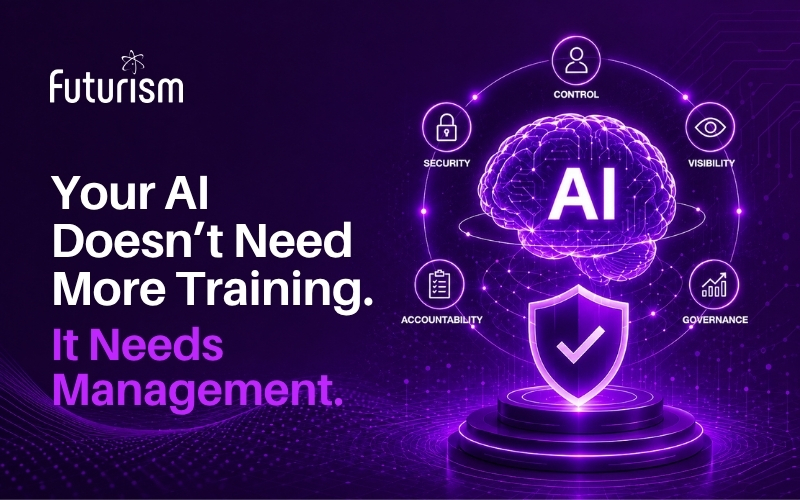
Your AI Doesn’t Need More Training. It Needs Management

Most enterprises today aren’t struggling to deploy AI. They’re struggling to govern it.
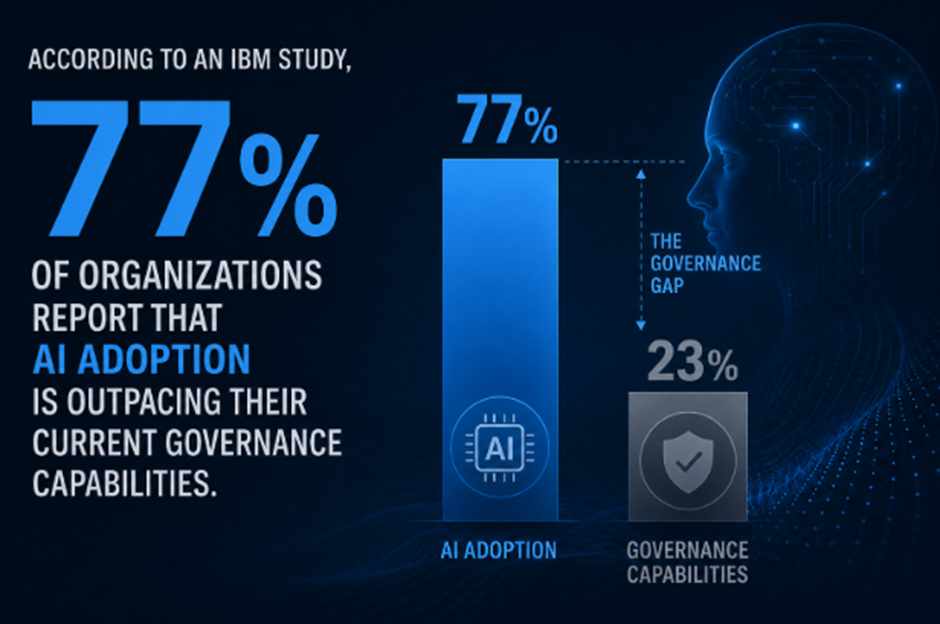
Organizations are rolling out copilots, assistants, and autonomous agents across departments, yet many still fail to achieve the expected business impact. According to an IBM study, 77% of organizations report that AI adoption is outpacing their governance capabilities.
The challenge is no longer what AI can do. It’s understanding what AI is doing, what data it can access, and how its actions are controlled. When organizations can’t answer those questions confidently, AI becomes a source of risk rather than value.
The most successful enterprises aren’t just deploying better AI. They’re building stronger foundations of trust, control, and accountability around it.
AI Agents Should Be Managed More Like Employees Than Software
Most organizations still view AI as another software application that sits somewhere in the technology stack. That mindset no longer reflects reality.
A modern AI agent can access business systems, analyze large volumes of data, draft communications, make recommendations, and in some cases take actions on behalf of employees. Its role increasingly resembles that of a digital worker rather than a traditional business application.
Yet enterprises rarely govern AI the way they govern people.
Every employee receives a defined role, clear responsibilities, specific permissions, and management oversight. There are processes for onboarding, performance reviews, compliance, and accountability.
AI agents often receive none of those controls.
Organizations spend enormous amounts of time evaluating what AI can do, but far less time defining what AI should be allowed to do. That’s where many promising AI initiatives begin to stall.
The enterprises creating lasting value from AI have learned that before they scale adoption, they must answer three fundamental questions.
Can We Trust the AI?
If trust is about confidence, control is about boundaries.
This is where many governance conversations become challenging. Traditional governance was built for employees and applications. Agentic AI sits somewhere in between.
An AI agent can access data, generate recommendations, and take actions across multiple systems within seconds. Without clear controls, that creates significant operational and security risks. The question enterprises should ask is simple:
If this AI agent were a human employee, would we be comfortable giving it the same level of access and autonomy?
For many organizations, the answer is no.
That’s why every AI agent needs a defined identity, clear responsibilities, and access limited to its role. Just as important are real-time guardrails that enforce policies while actions are taking place, not after the fact.
When organizations establish these boundaries, AI becomes easier to scale because leaders know exactly what it can and cannot do.
Control doesn’t slow innovation. It gives organizations the confidence to pursue bigger opportunities.
Read Also: Is Agentic AI Safe for Enterprises? Governance, Risk Controls and Real-World Deployment
Can We Scale AI Safely?
Launching an AI pilot is relatively easy. Scaling AI-powered automation across departments is where complexity begins.
The difference between a successful pilot and a successful enterprise-wide deployment usually has very little to do with the model itself. More often, it comes down to infrastructure, oversight, and consistency.
As AI expands across departments, enterprises need confidence that governance standards remain intact. They need visibility into how systems are performing, how data is being used, where risks are emerging, and whether controls continue to work as expected.
Most importantly, organizations need a complete and defensible record of what their AI systems are doing. When an auditor, regulator, board member, or customer asks why a particular decision was made, there should be a clear answer supported by evidence rather than assumptions.
This is where governance stops being a policy document and becomes an operational capability.
The organizations succeeding with AI treat governance as infrastructure. They view it as a permanent part of the business rather than a compliance exercise completed during deployment.
The Shift Enterprises Need to Make
Many enterprises don’t need another AI pilot.
They don’t need another tool demonstration. They don’t need another proof of concept. What they need is confidence that AI operates within approved boundaries, risks are managed, and leaders can defend AI-driven decisions.
The enterprises that gain the most value from AI over the next few years will not be the ones experimenting fastest.
They will be the ones building trust the fastest. Because the real question is not: “What can our AI do?”
The real question is: “Can we confidently explain, govern, and scale what our AI is doing?”
That’s the difference between an AI experiment and an AI-powered enterprise.
Conclusion:
Many AI initiatives don’t fail because the models are weak.
They fail because organizations can’t answer basic questions about access, accountability, oversight, and risk.
Futurism AI helps enterprises solve those challenges by embedding governance directly into AI systems from the beginning, enabling organizations to deploy, manage, and scale AI with confidence.
The future belongs to companies that can trust their AI as much as they trust their people.
If you’re ready to move beyond pilots and build AI that can operate securely at enterprise scale, talk to the Futurism AI team today.
Frequently Asked Questions:
1. What is AI governance?
AI governance is the set of processes, controls, and technologies that help organizations manage how AI systems are used. It includes access control, monitoring, auditing, risk management, and accountability.
2. Why is AI governance important?
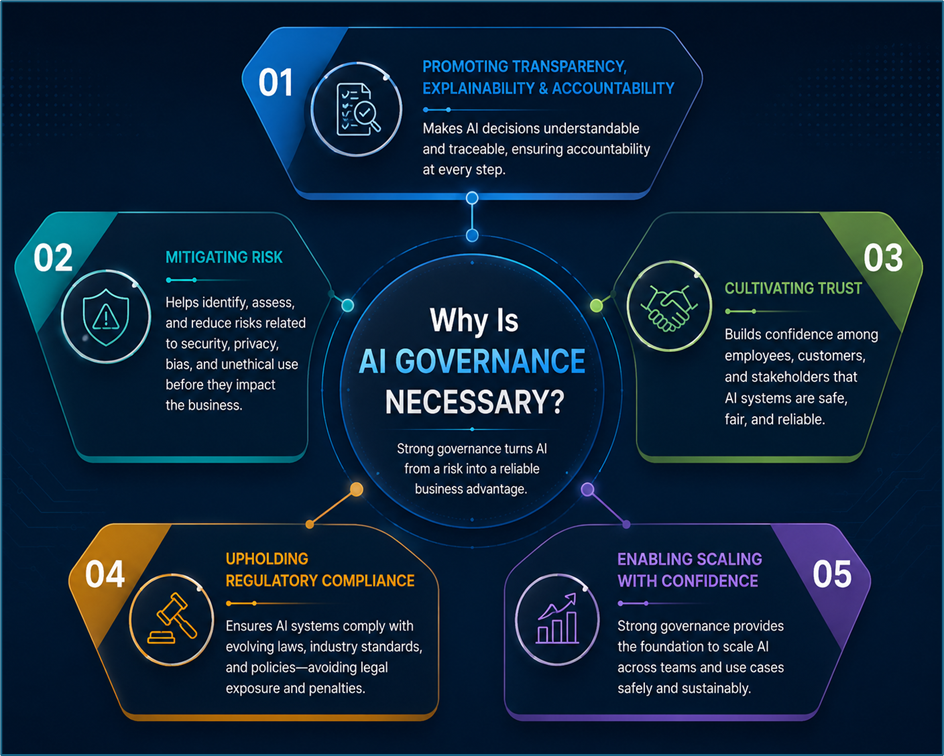
Without governance, organizations may struggle with security risks, compliance issues, unauthorized actions, and a lack of visibility into how AI systems operate. Governance helps enterprises use AI safely and responsibly.
3. Should every AI system have the same governance controls?
No. Governance should be based on risk. A meeting-summary assistant requires less oversight than an AI system involved in hiring, lending, healthcare, or financial decisions.
4. How can organizations tell if their AI governance is working?
A simple test is this: Can you quickly identify every AI system accessing sensitive data, explain what it’s authorized to do, and show who approved it? If not, your governance likely exists on paper rather than in practice.
TRENDING POSTS
-
NLP in 2026: Trends, Challenges, and Real-World Impacts Shaping Global Business
-
How Agentic AI Improves Enterprise Workflows without Replacing Teams
-
Is Agentic AI Safe for Enterprises? Governance, Risk Controls and Real-World Deployment
-
Agentic AI vs Automation: What Enterprise Leaders Need to Know
-
Agentic AI for Enterprises: Use Cases, Architecture and Adoption Strategy