Enterprise AI Solutions: From AI Adoption to Measurable ROI

Somewhere in your organization right now, a competitor’s AI agent is closing a deal, resolving a customer complaint, or flagging a fraud pattern, without any human intervention.” That’s not a hypothetical. That’s a reality today.
For years, “AI strategy” meant a slide deck with a chatbot pilot and a vague promise to “explore machine learning.” That era is over. As we head into 2027, enterprise AI has quietly shifted from an innovation lab experiment to core operating infrastructure, the kind of thing that shows up on board agendas next to supply chain risk and cybersecurity, not next to “digital transformation buzzwords.”
The uncomfortable truth for enterprises is this: adopting some AI is no longer a differentiator. Almost everyone has done that. The real question is whether your organization has a coherent strategy, a framework, a governance model, a roadmap, or whether you’re stitching together disconnected tools and hoping they add up to transformation. This guide is built to help you tell the difference, and to give you a practical way forward.
What Are Enterprise AI Solutions?
Enterprise AI solutions are systems that are purpose-built to operate at organizational scale across departments, data sources, compliance requirements, and thousands of concurrent users, rather than as isolated point tools.
Where consumer AI apps solve one narrow problem for one person, AI solutions for enterprises are engineered to integrate with existing systems (CRM, ERP, data warehouses), respect enterprise-grade security and access controls, and support workflows that span sales, operations, finance, HR, and customer service simultaneously.
A home espresso machine can make a great cup of coffee. But you wouldn’t run a national coffee chain on one. The same principle applies to AI: a consumer AI tool can be impressive in the hands of one user, but enterprise AI must be built to operate securely, reliably, and consistently across systems, teams, and thousands of business processes.
Why Enterprise AI Is Becoming a Business Imperative
Enterprise AI adoption has climbed to roughly 78% to 91% – as organizations are using AI in at least one business function. That’s one of the fastest sustained technology adoption curves in recent times.
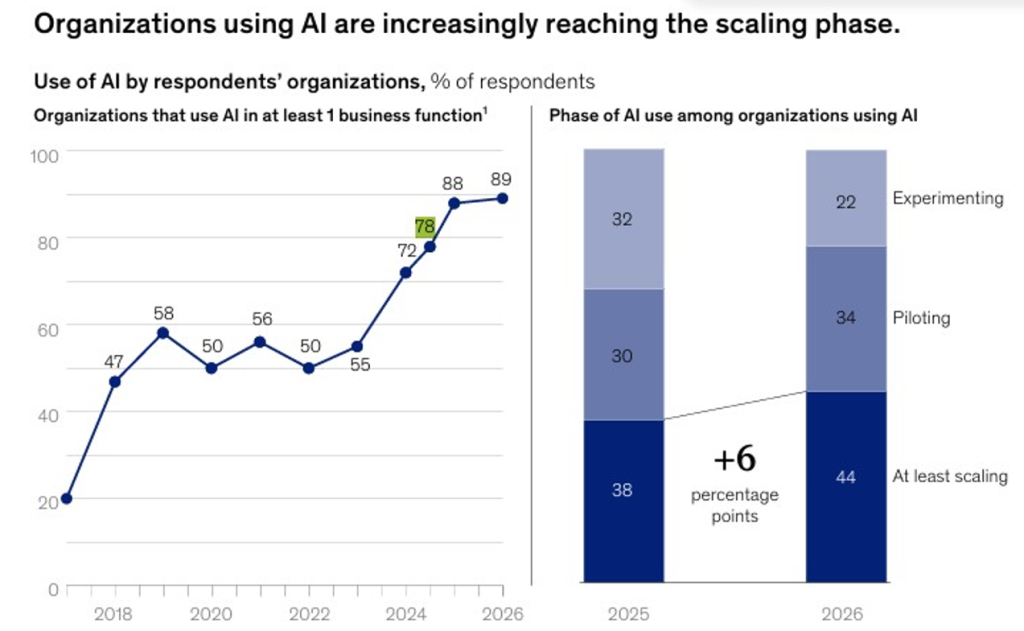
But adoption alone doesn’t tell the full story. What’s changed heading into 2027 is depth. Companies aren’t running single pilot projects anymore. Many enterprises now operate multiple AI models in production simultaneously, embedded directly into daily operations rather than sitting in an innovation sandbox. AI has stopped being a side project owned by IT and started becoming infrastructure owned by the business.
This shift is being driven by three converging pressures: rising customer expectations for instant, personalized service; margin pressure that makes manual, repetitive work economically indefensible; and competitive dynamics where early AI adopters compound their advantage in speed and cost efficiency every quarter they stay ahead.
What Makes an Enterprise AI Platform Different?
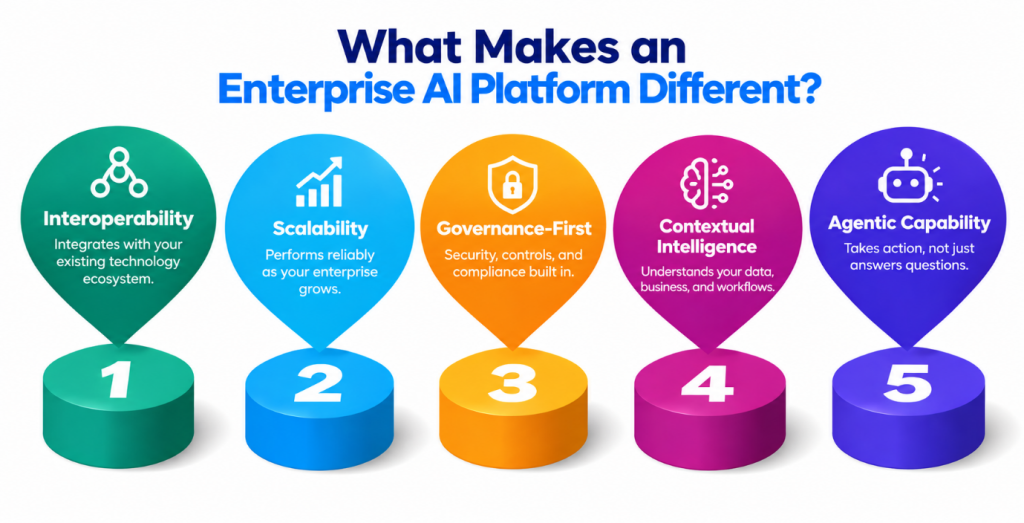
Not all AI tools are created equal, and the distinction matters more than most vendors admit. A true enterprise AI platform is defined by a few non-negotiable characteristics:
- Interoperability: It plugs into your existing tech stack rather than forcing a rip-and-replace.
- Scalability: It performs the same on day one thousand as it did in the pilot, across every business unit and geography.
- Governance-First Design: Access controls, audit trails, and compliance guardrails are built in, not bolted on later.
- Contextual Intelligence: The system understands your business data, terminology, and workflows, not just generic internet knowledge.
- Agentic Capability: Increasingly, enterprise platforms don’t just answer questions; they take multi-step actions autonomously, a category now widely referred to as Agentic AI Solutions.
If an AI development company can’t speak clearly to all five, you’re likely looking at a point solution dressed up as a platform.
Enterprise AI Strategy Framework
A durable enterprise AI strategy for 2027 tends to follow a repeatable framework, regardless of industry:
- Assess: Audit where manual, repetitive, or data-heavy processes are draining time and money. Most organizations discover their highest-value AI opportunities sit in unglamorous back-office workflows, not flashy customer-facing use cases.
- Prioritize: Rank opportunities by a simple matrix: business impact versus implementation complexity. Start where impact is high and complexity is manageable.
- Pilot with Intent: Run pilots designed to prove ROI within a defined window, not open-ended experiments that never graduate to production.
- Scale Deliberately: Move successful pilots into full deployment with governance, training, and change management built in from day one.
- Govern Continuously: Treat AI governance as an ongoing discipline, not a one-time compliance checkbox.
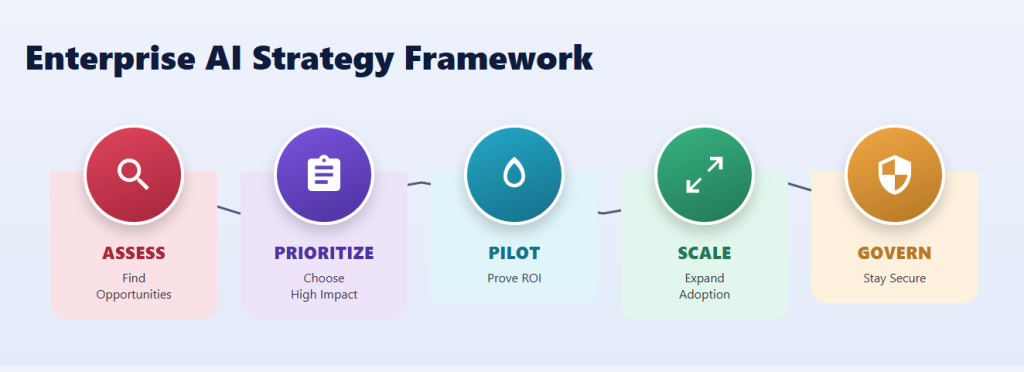
Organizations that follow a structured framework like this consistently outperform those running scattered, uncoordinated experiments. The difference between AI activity and AI-driven ROI often comes down entirely to whether this kind of system exists.
Top Enterprise AI Solutions Every Organization Should Consider
While every business’s needs differ, a handful of AI solutions for enterprise consistently deliver measurable value across industries:
- Enterprise conversational AI for customer support, internal helpdesks, and employee self-service
- Agentic AI for executing multi-step workflows autonomously, from procurement approvals to lead qualification
- Predictive analytics platforms for demand forecasting, churn prediction, and risk modeling
- Document intelligence systems that extract, summarize, and act on unstructured data at scale
- Enterprise AI software for process automation across finance, HR, and operations
The common thread across all of these: they’re chosen not because they’re trendy, but because they map directly to a measurable business outcome.
Enterprise AI Chatbot Solutions: Use Cases
An enterprise AI chatbot solution today looks nothing like the scripted, frustrating bot of the early 2020s. Modern enterprise conversational AI can:
- Resolve complex customer service inquiries end-to-end, including account changes and troubleshooting, without human handoff
- Serve as an internal knowledge assistant, answering employee questions about policy, benefits, or IT issues instantly
- Qualify and route sales leads in real time, 24/7, across time zones
- Support multilingual customer bases without separate regional teams
- Integrate with backend systems to actually complete actions, such as processing a refund, not just explaining the refund policy
The bar has moved from “can it talk like a human” to “can it get real work done like a competent employee.”
Read Also: From Chatbots to AI Agents: The Next Evolution of Enterprise AI
Enterprise AI Governance and Security
As AI systems gain more autonomy, governance stops being optional. Enterprise AI governance means establishing clear answers to hard questions before deployment: Who is accountable when an AI agent makes a decision? What data can it access, and what’s off-limits? How are outputs audited and corrected? What happens when the system encounters something outside its scope?
Security considerations compound this further. Enterprise AI systems often touch sensitive customer data, financial records, and proprietary business logic, making data encryption, access controls, and compliance alignment (SOC 2, GDPR, HIPAA, depending on industry) foundational, not optional add-ons. The organizations that build governance in from the start avoid the costly, reputation-damaging retrofits that others face later.
Common Challenges in Enterprise AI Adoption
Despite the enthusiasm, most enterprises still struggle to convert AI activity into full-scale value. A large majority of organizations report using AI in some capacity, yet only a small fraction describe themselves as having reached true AI maturity. The gap usually comes down to a familiar set of obstacles:
- Fragmented data that isn’t clean, connected, or accessible enough to power reliable AI
- Talent gaps, particularly around AI governance and applied deployment (not just model-building)
- Change resistance from teams who see AI as a threat rather than a tool
- Unclear ownership: Is AI strategy owned by IT, operations, or the C-suite?
- Pilot purgatory, promising experiments that never get funded or scaled into production
None of these challenges are insurmountable, but they do require deliberate strategy, not enthusiasm alone.
Why Futurism AI for Enterprise AI Solutions
As enterprise AI moves from experimentation to infrastructure, the organizations that win in 2027 and beyond will be the ones with a real strategy, not just a tool stack. That’s precisely the gap Futurism AI was built to close.
We work with enterprises to design, deploy, and govern AI systems that go beyond simple automation, including sophisticated Agentic AI Solutions engineered to operate reliably at enterprise scale.
If your organization is still running disconnected pilots, now is the moment to change that. Explore how Futurism AI can help you build an enterprise AI roadmap that actually delivers ROI.
FAQs
1. What’s the difference between enterprise AI solutions and regular business AI tools?
Enterprise AI solutions are built for scale, security, and integration across an entire organization, supporting thousands of users, connecting to core business systems, and meeting compliance requirements. Regular AI tools are typically designed for individual or team-level use and lack the governance and scalability enterprises require.
2. How long does it take to see ROI from an enterprise AI platform?
Timelines vary by use case, but organizations that follow a structured framework of piloting, measuring, and scaling commonly see meaningful returns within the first year of production deployment, particularly in high-volume, repetitive workflows like customer service and document processing.
3. What is Agentic AI, and how is it different from traditional AI tools?
Agentic AI refers to AI systems that can take multi-step actions autonomously, not just answering a question but completing a task end-to-end, such as processing an approval or resolving a customer issue without human intervention at each step.
4. What should a company evaluate before choosing an enterprise AI vendor?
Look beyond the demo. Evaluate integration capability with existing systems, data security and governance features, scalability across departments, and whether the vendor can demonstrate measurable outcomes from comparable enterprise deployments, not just impressive technology.
TRENDING POSTS
-
NLP in 2026: Trends, Challenges, and Real-World Impacts Shaping Global Business
-
How Agentic AI Improves Enterprise Workflows without Replacing Teams
-
Is Agentic AI Safe for Enterprises? Governance, Risk Controls and Real-World Deployment
-
Agentic AI vs Automation: What Enterprise Leaders Need to Know
-
Agentic AI for Enterprises: Use Cases, Architecture and Adoption Strategy