How Agentic AI Improves Enterprise Workflows without Replacing Teams

Futurism Technologies
February 6, 2026 - 5.2K
5 Min Read
Did you know? Most U.S. enterprises plan to expand AI use in operational workflows this year.
Every enterprise leader wants smoother workflows. No leader wants workforce disruption.
That tension sits at the center of nearly every conversation around Agentic AI in enterprises today.
Operations, IT and engineering teams are already under pressure managing complex systems, fragmented tools and rising expectations for speed and reliability. When AI agents enter the discussion, a reasonable concern follows:
Will this technology replace people or actually help teams work better?
In real-world enterprise deployments, the answer is clear: Agentic AI improves workflows by reducing friction, not headcount.
It removes invisible coordination work, manages complexity across systems and allows teams to focus on judgment, strategy and high value decisions. This is how Agentic AI workflows create impact without replacing teams.
Why Workflow Friction Limits Enterprise Scale
Most enterprise inefficiency doesn’t come from lack of talent or effort. It comes from workflow friction.
Common friction points include:
- Manual handoffs between teams
- Context loss across systems
- Delays caused by approvals and dependencies
- Rework due to incomplete or inconsistent information
- Exception handling that pulls experts into routine coordination
Research consistently shows that knowledge workers spend 20–30% of their time simply coordinating work, not executing it. As organizations scale, this friction multiplies slowing execution and increasing operational cost.
Traditional automation can help, but only within rigid, predefined processes. Enterprise workflows are rarely that simple.
Where Manual Handoffs Slow Organizations Down
Manual handoffs are one of the most underestimated drains on enterprise productivity.
Typical examples include:
- Support tickets passed across tiers without full context
- IT incidents escalated with partial diagnostics
- Operations workflows paused for validation or approvals
- Engineering teams waiting on upstream decisions
Each handoff introduces delay, miscommunication and dependency on human availability. Rule based automation removes some steps, but breaks down when workflows become cross functional, exception heavy or dynamic.
This is where Agentic AI workflows fundamentally change how work moves through the enterprise.
How Agentic AI Coordinates Across Enterprise Systems
Agentic AI goes beyond basic automation by actively coordinating decisions and actions to drive real business outcomes across enterprise workflows.
In enterprise environments, AI agents for operations are designed to:
- Understand the goal of a workflow
- Break work into logical steps
- Decide which systems and tools to interact with
- Maintain context across platforms
- Escalate to humans only when judgment or approval is required
Instead of people acting as connectors between ERP, CRM, ITSM and analytics tools, AI agents handle coordination. Teams stay focused on decisions that require human expertise.
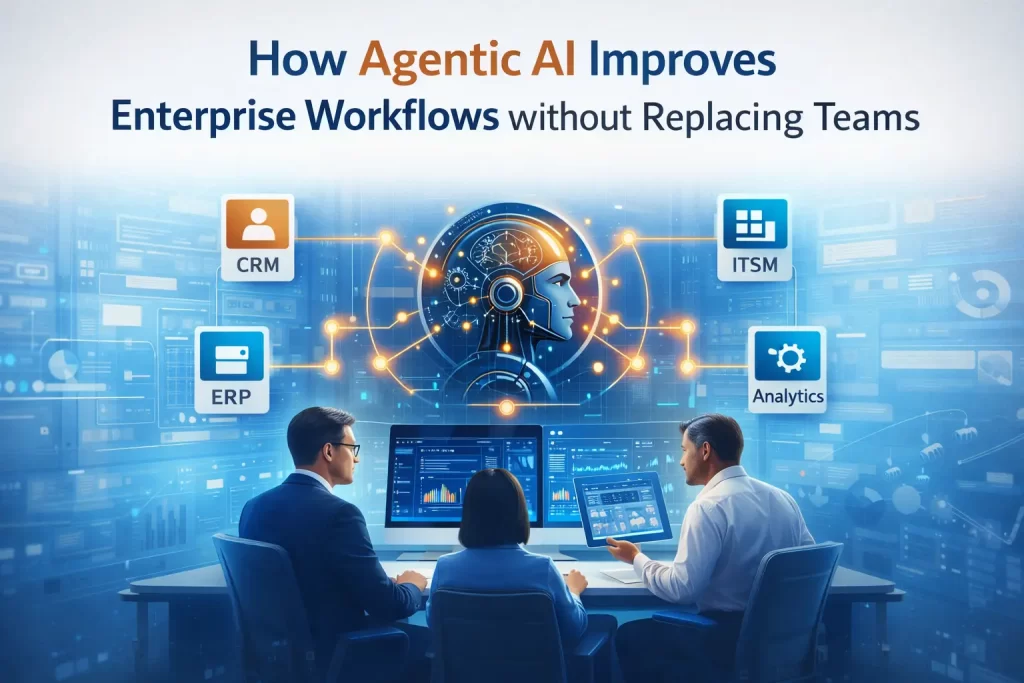
This marks a critical shift: from task execution to intelligent workflow management.
Real Enterprise Workflow Examples
Customer Support Operations
Before Agentic AI
- Ticket routing automation
- Manual investigation across systems
- Multiple escalations
- Repeated customer explanations
With Agentic AI
- Agents analyze incoming issues
- Pull customer and interaction history from CRM
- Check billing, usage and policy systems
- Trigger resolution workflows automatically
- Escalate only complex cases with full context
Result: Faster resolution times, lower agent burnout and improved customer experience.
IT Operations and Incident Management
Before Agentic AI
- Alert storms
- Manual triage
- Reactive remediation
- Dependence on tribal knowledge
With Agentic AI
- Agents correlate signals across logs and metrics
- Identify likely root causes
- Execute predefined remediation actions
- Notify engineers with actionable insights
Result: Reduced downtime, faster incident resolution and fewer late night escalations.
Also explore how our AI-based cyber threat detection and response enhances IT operations by accelerating threat identification and reducing response time.
Operations and Business Process Management
Before Agentic AI
- Static workflows
- Frequent exceptions
- Manual overrides
- Slow cycle times
With Agentic AI
- Agents adapt workflows in real time
- Handle exceptions intelligently
- Coordinate approvals and validations
- Optimize flow continuously
Result: Smoother operations without constant process redesign.
To see how these capabilities come together in real-world operations, explore our AI-powered business process automation solutions designed for enterprise scale workflows.
Human + AI Collaboration Models That Actually Work
Successful enterprises don’t deploy Agentic AI to replace work they deploy it to rebalance work.
Effective collaboration models include:
- AI as coordinator: Agents manage flow; humans make final decisions
- AI as assistant: Agents prepare insights and recommendations
- AI as executor (low-risk): Agents handle routine actions within guardrails
- Humans as supervisors: Teams oversee, audit and improve systems
This approach preserves accountability while reducing cognitive load. Notably, organizations adopting Agentic AI for workflow optimization often report higher employee satisfaction, not lower because teams spend less time coordinating and more time solving meaningful problems.
Productivity Impact: What the Data Shows
Enterprise data consistently points to measurable gains:
- 30 – 50% improvements in process efficiency across operations heavy functions
- 40%+ faster incident resolution in IT operations using AI-driven orchestration
- Significant reductions in ticket handling time and escalation volume in support teams
These improvements come from workflow acceleration, not workforce reduction. The value of Agentic AI lies in speed, consistency and context.
Change Management: Making Agentic AI Adoption Stick
Technology alone doesn’t improve workflows adoption does.
Leading enterprises focus on:
- Clear communication about AI’s role
- Training teams to collaborate with AI agents
- Starting with assistive, low-risk use cases
- Involving frontline teams early
- Measuring outcomes transparently
When leaders frame Agentic AI as operational infrastructure rather than disruption, adoption accelerates naturally.
Why Agentic AI Strengthens Teams Instead of Replacing Them
Agentic AI removes the invisible work that slows teams down:
- Context switching
- Manual coordination
- Repetitive validation
- Exception triage
What remains is human judgment, creativity and accountability.
This is why adoption of Agentic AI in enterprises is increasingly driven by operations, IT and engineering leaders not just innovation teams.
To see where these benefits apply most effectively, explore enterprise use cases of Agentic AI in our in-depth guide.
FAQs: Agentic AI Workflows
What are Agentic AI workflows?
Agentic AI workflows are goal driven processes managed by AI agents that coordinate actions across systems, adapt to exceptions and involve humans only when judgment is required.
How is Agentic AI different from traditional automation?
Automation follows predefined rules. Agentic AI dynamically manages workflows, makes decisions and optimizes execution across tools and teams.
Can AI agents integrate with existing enterprise systems?
Yes. AI agents for operations are designed to integrate securely with ERP, CRM, ITSM and other enterprise platforms.
Is Agentic AI safe for enterprise operations?
When deployed with governance, audit logs and human in the loop controls, Agentic AI is suitable for mission critical environments.
Explore Agentic AI for Workflow Optimization
Every enterprise workflow is unique. The real opportunity isn’t asking whether Agentic AI can help it’s identifying where it delivers the greatest impact.
At Futurism AI, we help enterprises apply Agentic AI workflows in practical, responsible ways that reduce friction without disrupting teams. As an enterprise grade AI solutions provider, we work closely with operations, IT and engineering leaders to:
- Identify high friction workflows across core business operations
- Design human centered Agentic AI systems aligned with real operational needs
- Integrate AI agents for operations safely into existing enterprise environments
- Improve speed, consistency and scalability without sacrificing control or accountability
If you’re evaluating Agentic AI in enterprises and want to move beyond experimentation, the next step is clarity.
Talk to our AI experts and explore how Agentic AI for workflow optimization can help your teams move faster, work smarter and scale without replacing them.