NLP in 2026: Trends, Challenges, and Real-World Impacts Shaping Global Business

Futurism Technologies
April 7, 2026 - 3.2K
5 Min Read
Imagine a global enterprise drowning in unstructured data: emails, customer interactions, social media feeds, and regulatory documents, representing up to 90% of all business information, yet largely inaccessible for real-time decision-making. Now picture unlocking that data instantly: machines not only reading human language, but also interpreting intent, detecting nuance, predicting outcomes, and driving autonomous actions across borders and languages.
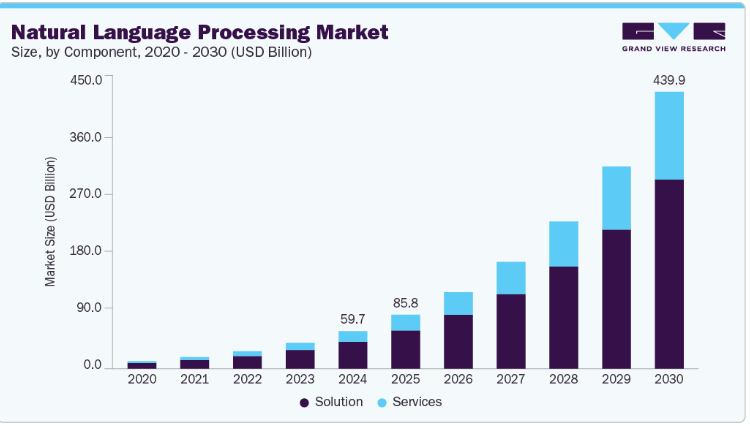
This is no longer science fiction. Natural Language Processing (NLP) has evolved into the foundational capability powering the next wave of enterprise transformation. According to Grand View Research, the global NLP market is projected to surpass $439.85 billion by 2030. For U.S. enterprises navigating regulatory complexity, competitive disruption, and digital acceleration, mastering NLP is no longer optional, it’s the difference between leading and lagging in an AI-driven economy.
As leaders in AI innovation at Futurism AI, we see NLP not merely as a tool, but as the bridge to intelligent, scalable systems that redefine industry boundaries.
What is NLP and Why It Matters
Natural Language Processing (NLP) is a branch of artificial intelligence (AI) that enables computers to understand, interpret, generate, and manipulate human language both written and spoken. It combines computational linguistics rule-based modeling of language with statistical and machine learning models to analyze text and speech, allowing machines to make sense of human communication.
Key Components and Techniques
NLP involves two main components:
- Natural Language Understanding (NLU): Focuses on understanding the intent, sentiment and meaning behind text.
- Natural Language Generation (NLG): Enables computers to produce human like language.
Key techniques include:
- AI-powered Sentiment Analysis: Detecting whether text conveys positive, negative, or neutral emotion.
- Named Entity Recognition (NER): Identifying people, places, or events.
- Machine Translation: Automatically translating text between languages.
- Speech Recognition: Converting spoken language into text.
- Summarization: Transforming complex text into brief, meaningful summaries for quick understanding.
Common Applications of NLP
- Virtual Assistants and Chatbots: Siri, Alexa and customer service bots.
- Language Translation: Apps like Google Translate.
- Email Filtering: Detecting spam and phishing attempts.
- Sentiment Analysis: Analyzing social media feedback and reviews.
- Information Extraction: Processing medical records or legal documents.
Real-World Impact: Proven Use Cases Across Industries
NLP is already delivering measurable ROI in high-stakes environments. Here are standout examples:
Healthcare
- NLP transforms unstructured clinical notes into actionable insights. A prominent case is Memorial Sloan Kettering Cancer Center’s collaboration with IBM Watson, where NLP analyzed vast oncology literature to support evidence based treatment recommendations accelerating decision making for complex cases (source: IBM case studies).
- More recently, providers leveraging platforms like John Snow Labs’ Healthcare NLP have achieved up to 30% faster processing of patient records while maintaining HIPAA compliance.
Finance
- JPMorgan Chase’s COiN platform uses NLP to review commercial loan agreements, reducing manual review time from 360,000 hours annually to seconds a landmark example of operational efficiency and risk reduction (source: JPMorgan public reports).
- Bank of America’s virtual assistant Erica, powered by advanced NLP has handled billions of client interactions delivering personalized financial guidance at scale.
Retail and eCommerce
- Amazon’s recommendation engine relies heavily on NLP-driven sentiment analysis of reviews and search queries, contributing significantly to its revenue through hyper personalization.
- Similarly, American Express uses real-time NLP to monitor customer sentiment across channels enabling proactive service adjustments (source: company disclosures).
Manufacturing and Logistics
- Allotrac’s AI assistant “Allie” employs conversational NLP for route optimization and job scheduling, earning the 2024 Mercury Award for Supply Chain Innovation by reducing errors and boosting productivity (source: Allotrac case study).
- HCL Technologies implemented NLP-driven cognitive automation for a North American transportation firm streamlining freight management and customer clearance processes for faster onboarding and efficiency gains.
These cases illustrate a clear pattern of enterprises deploying mature NLP solutions see 20-40% improvements in efficiency, accuracy and customer satisfaction.
Challenges and Solutions
While Natural Language Processing (NLP) is transforming industries, enterprises often face significant hurdles when adopting NLP services. Addressing these challenges head on is critical to building trust and ensuring ROI.
Challenge 1: Data Privacy and Compliance
Enterprises in the U.S. must comply with strict regulations like HIPAA (healthcare), GDPR (global data protection) and CCPA (California Consumer Privacy Act). Handling sensitive customer and patient data through NLP tools raises concerns about privacy, security and compliance.
Futurism AI’s Solution: Our Natural Language Processing solutions are built with privacy first architecture. We integrate advanced encryption, anonymization and compliance frameworks to ensure that every NLP model aligns with U.S. regulatory standards. This means healthcare providers, financial institutions and government agencies can confidently deploy NLP services without risking violations.
Challenge 2: Bias in NLP Models
NLP models can unintentionally inherit biases from training data, leading to skewed insights, unfair outcomes or inaccurate predictions. For enterprises, this can damage brand reputation and decision making.
Futurism AI’s Solution: We implement bias detection and mitigation protocols across our NLP solutions. By continuously auditing datasets, applying fairness algorithms and retraining models with diverse, representative data, Futurism AI ensures that NLP solution delivers ethical, unbiased, and trustworthy results.
Challenge 3: Integration with Legacy Systems
Many enterprises still rely on legacy IT infrastructure. Integrating modern NLP solutions with outdated systems can be complex, costly and time consuming.
Futurism AI’s Solution: Our NLP for enterprise applications is designed with modular APIs and flexible integration layers. Whether it’s a legacy ERP system in manufacturing or a traditional CRM in retail, Futurism AI ensures seamless interoperability. This reduces downtime, accelerates adoption and maximizes ROI without requiring a complete system overhaul.
By addressing these challenges, Futurism AI positions itself as a trusted partner for U.S. enterprises, delivering scalable, ethical and compliant NLP services that solve real business problems.
Traditional vs. NLP Powered Workflows
Our clients, spanning U.S. healthcare systems, financial institutions, and manufacturers, consistently achieve faster time-to-value and sustained ROI because these challenges are solved by design.
| Workflow | Traditional Approach | NLP‑Powered Approach |
|---|---|---|
| Customer Support | Manual ticket resolution, long wait times | AI‑powered chatbots offering instant, personalized responses |
| Compliance | Manual audits, error‑prone reporting | Automated NLP compliance checks with real‑time monitoring |
| Healthcare Diagnostics | Human‑only review of patient records | NLP‑assisted predictive diagnostics, faster and more accurate |
| Financial Risk Analysis | Manual fraud detection, reactive measures | NLP models detecting anomalies proactively, reducing fraud losses |
| Manufacturing Reports | Paper based reporting, delayed insights | NLP tools automating production reports, enabling real‑time decisions |
| Retail Sentiment Analysis | Manual review of customer feedback | NLP services analyzing thousands of reviews instantly for actionable insights |
| Logistics Communication | Email chains, miscommunication delays | NLP‑powered translation services ensuring clarity across global supply chains |
Future of NLP in AI
- Emotion AI: NLP models detecting sentiment and emotional tone.
- Multimodal NLP: Combining text, images and video for richer insights.
- Privacy First NLP Tools: Ensuring compliance with U.S. regulations like HIPAA and GDPR.
- Real-Time AI-powered Translation Services: Breaking language barriers in global enterprises.
- Agentic AI + NLP: Autonomous agents making decisions based on natural language inputs.
Conclusion
For U.S. enterprises, Natural Language Processing is not just a technology it’s a competitive advantage. From healthcare diagnostics to financial fraud prevention, NLP solutions are transforming industries by unlocking the power of unstructured data. Futurism AI stands at the forefront, delivering scalable, ethical, and ROI-driven NLP services that empower organizations to thrive in the digital future.
Empower your enterprise with NLP to turn unstructured data into actionable intelligence.
Contact Futurism AI today for a personalized consultation.
People Ask:
What is Natural Language Processing (NLP)?
Natural Language Processing (NLP) is a branch of artificial intelligence (AI) that enables computers to understand, interpret, generate and manipulate human language both written and spoken.
What are common applications of NLP in enterprises?
Common NLP applications in enterprises include customer service chatbots, sentiment analysis of customer feedback, automated document processing (invoices/contracts) and text summarization to boost productivity.
How does NLP improve healthcare?
By analyzing clinical notes, automating diagnostics and enabling multilingual patient communication.
What are the challenges of NLP?
Data privacy, bias in NLP models and integration with legacy systems.
What are the best NLP tools for enterprises?
Sentiment analysis tools, AI-powered translation services, and document summarization platforms.
Is NLP secure for financial applications?
Yes, when combined with compliance frameworks, NLP services can enhance fraud detection and reporting.
What is the future of NLP in AI?
Emotion detection, multimodal NLP, privacy first solutions and autonomous decision making agents.
TRENDING POSTS
-
NLP in 2026: Trends, Challenges, and Real-World Impacts Shaping Global Business
-
How Agentic AI Improves Enterprise Workflows without Replacing Teams
-
Is Agentic AI Safe for Enterprises? Governance, Risk Controls and Real-World Deployment
-
Agentic AI vs Automation: What Enterprise Leaders Need to Know
-
Agentic AI for Enterprises: Use Cases, Architecture and Adoption Strategy