

Executive Summary
A leading U.S.-based automotive parts manufacturer struggled with costly unplanned downtime, manual quality checks that missed subtle defects and volatile demand signals that created excess inventory and stockouts. Futurism AI partnered with the client to deploy an integrated AI stack computer vision for automated optical inspection (AOI), predictive maintenance for CNC and stamping lines and a demand sensing forecasting model powered by multimodal data. Within six months, the plant reduced unplanned downtime by 22%, improved first pass yield by 3.7 points and cut customer returns by 31%. Cycle-time adherence improved, enabling a 15% increase in throughput without adding headcount. The combined impact: $4.3M in annualized savings, including scrap reduction, avoided expedited freight and maintenance cost optimization. The manufacturer is now scaling the solution across two additional plants, with a roadmap to expand AI-driven scheduling and supplier risk sensing.
The Client
Our client is a Tier-1/Tier-2 automotive parts manufacturer in the United States producing precision machined components, subassemblies and stamped metal parts for leading OEMs. With multiple facilities operating 24/7, the company runs high-mix, medium volume production with rigorous PPAP and APQP compliance requirements. Quality tolerance is measured in microns and any lapse in defect detection or line reliability translates directly into chargebacks, missed OTIF targets and compressed margins.
The Challenge
Despite a mature lean program and strong MES discipline, the plant was wrestling with three interlocking issues:
- Unplanned Downtime: CNC spindles, conveyors and stamping presses experienced unpredictable failures, leading to bottlenecks and missed takt time commitments. Mean Time Between Failures (MTBF) was trending downward while reactive maintenance costs were rising.
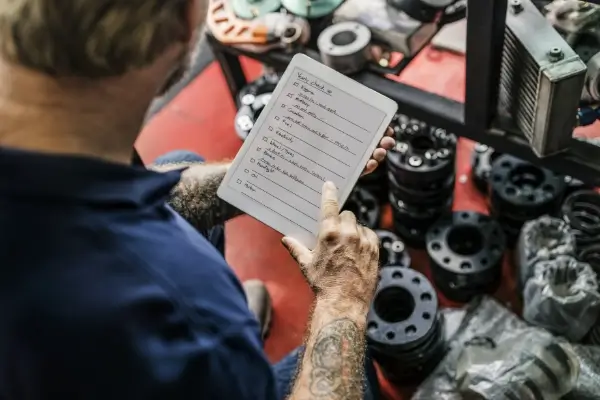
- Manual Quality Checks: Human inspectors could not consistently detect microdefects such as burrs, surface abrasions, and hairline cracks at full line speed, especially across multiple SKUs and tooling setups. False negatives led to rework and returns, false positives slowed throughput.
- Inaccurate Demand Forecasting: Legacy forecasting approached demand at the aggregate family level, ignoring near-real-time signals from dealer sales, macro indicators and aftermarket e-commerce. The result, excess inventory on slow movers, stockouts on fast movers and frequent schedule changes that destabilized operations.
The net effect was elevated scrap and rework, volatile OEE and avoidable logistics costs adding millions in annual inefficiencies.
Futurism AI Solution
Computer Vision for Automated Quality Inspection (See)
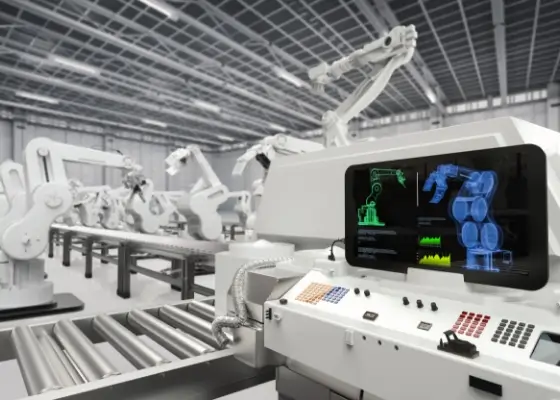
- What we built: A multi-camera AOI system using high-resolution industrial cameras and controlled lighting, coupled with a deep convolutional neural network optimized for defect classification and anomaly detection.
- Data used:
- 1.8M labeled images from historical inspections (augmented with synthetic variants to account for lighting, angle and surface variability)
- Golden samples and defective exemplars spanning 27 defect classes (burrs, tool marks, coating discontinuities, dimensional variance)
- Real-time line images captured at up to 60 FPS
- How it works: The model performs per-part inference in under 120 ms, triggering automated diverters for suspect parts and pushing classifications back to MES for traceability. Active learning loops feed inspector-confirmed outcomes back into the training set, improving model precision over time.
- Change management: We introduced a tiered-review workflow operators see explainability overlays (heatmaps) so trust builds gradually while false positives reduce.

Predictive Maintenance for Critical Assets (Predict)
- What we built: An asset health model combining vibration signatures (accelerometers), thermal data (IR cameras), acoustic emissions and machine logs (spindle load, torque, RPM).
- Data used:
- 14 months of historical breakdown and maintenance logs
- IoT sensor streams at 1–5 kHz for high-frequency vibration and acoustics
- SCADA/MES signals for duty cycles, micro-stops, and quality correlations
- How it works: We applied feature engineering (spectral kurtosis, envelope analysis, harmonics) and trained gradient-boosted ensembles and LSTM-based sequence models to predict failure windows (7–14 days out) with prioritized maintenance recommendations. The system generates work orders automatically in the CMMS with SKU and tool specific context.
- Impact on operations: Maintenance shifts from reactive to condition based, balancing uptime with spare parts availability.

Demand Sensing and AI Forecasting (Orchestrate)
- What we built: A hierarchical forecasting engine that blends classical time series decomposition with machine learning regressors and attention-based models for short term demand sensing.
- Data used:
- 3 years of order history by SKU and channel
- Dealers sell through data, aftermarket e-commerce signals, promotional calendars
- Macro indicators (vehicle registrations, PMI), weather anomalies and fuel price indexes
- How it works: The system updates weekly at the SKU location level, pushing netted demand into MRP while enforcing service level constraints and safety stock policies. Planners can scenario test (e.g., supplier delay, surge order) and view confidence intervals to fine tune schedules.
Architecture and Integration
- Edge + Cloud: On-prem edge inference for sub-200 ms AOI latency, cloud training pipelines for retraining and model registry.
- Connectors: Standards based integration with MES, SCADA and CMMS, secure data governance with role-based access and full audit trails.
- Human in the loop: Operators and quality engineers validate edge cases, ensuring continuous improvement and compliance with customer-specific specs.
Results
22% reduction in unplanned downtime across CNC and stamping assets, driven by condition-based maintenance and earlier detection of bearing wear and misalignment.
3.7 percentage-point gain in first-pass yield (FPY), primarily from AOI catching micro-defects at line speed.
31% reduction in customer returns and chargebacks, aided by improved traceability and consistent inspection quality.
15% increase in throughput without additional headcount, by cutting inspection cycle time and reducing rework loops.
$4.3M in annualized savings, broken down as:
- ~$1.6M reduced scrap and rework
- ~$1.2M avoided expedited freight and schedule turbulence
- ~$900K maintenance optimization (spares and labor)
- ~$600K warranty/chargeback reductions
Forecast accuracy improved from 72% to 91% (MAPE ↓ from 28% to 9%), enabling better inventory positioning and fewer last-minute changeovers.
OEE up by 6.4 points, with more stable cycle times and higher planned uptime.

Why It Worked
- Right problem framing: We prioritized a narrowly defined pilot line with the highest combined cost of downtime and scrap, proving ROI before scaling.
- Data depth - model novelty: High-quality labels, sensor fidelity and edge explainability mattered more than algorithmic novelty.
- Operator first design: Heatmaps, intuitive dashboards and clear SOPs built trust and sustained adoption.
- Seamless fit with existing systems: No rip and replace just precise, standards-based integration.
About Futurism AI
Futurism AI is an AI development partner for industrial leaders, specializing in computer vision, predictive maintenance and demand intelligence. We deliver secure, scalable AI that integrates with your MES, SCADA, CMMS and ERP, turning data into throughput, yield and profit.
Ready to see similar results?
If you’re a COO or Plant Manager looking to turn quality, maintenance or planning into competitive advantage, we can start with a focused line level pilot and deliver ROI in one quarter then scale with confidence.