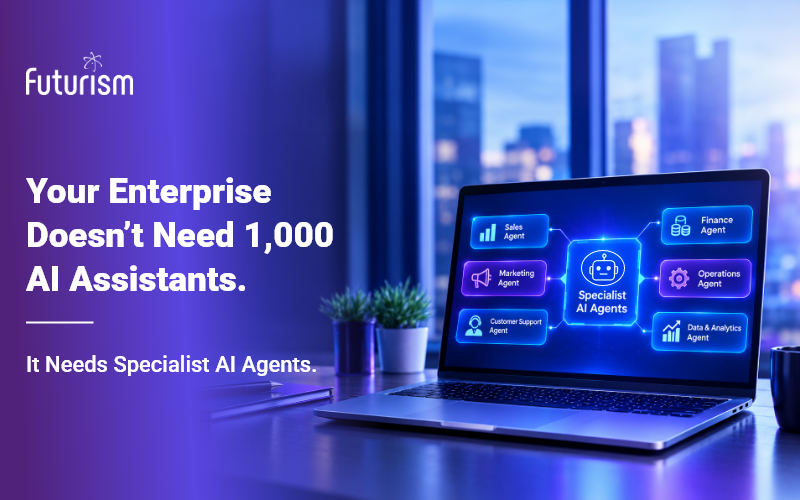
Your Enterprise Doesn’t Need 1,000 AI Assistants. It Needs Specialist AI Agents.

For years, enterprise AI has been moving toward a simple promise: give employees intelligent software that can help them work faster.
First came chatbots. Then copilots. Then AI assistants that could write, summarize, analyze, search, and recommend. Now the conversation is changing again.
And today, we have always-on specialist AI agents designed to work toward goals, use connected tools, retain context, and carry out work with varying levels of human oversight.
Enterprise AI is moving from general assistance toward specialization. And that raises a more important question for business leaders: What should an AI agent actually own?
The answer is probably not “everything.”
It is a defined responsibility with a clear objective, access to the right information and systems, boundaries around what it can do, and a path to escalate decisions that require human judgment. That is where specialist AI agents become strategically interesting.
Enterprise AI Works Best When It Has a Clear Role
Businesses aren’t built around a universal role. They have finance, procurement, customer service, sales, IT, and supply chain teams, each with unique workflows, systems, and responsibilities.
So why treat enterprise AI as one generic assistant?
Specialist agents are designed to own specific business functions, not be jacks of all trades. The shift is already happening. Research predicts that by 2028, agentic AI will autonomously make at least 15% of day-to-day work decisions, up from virtually none in 2024.
Instead of asking, “What can our AI do?”
Enterprise leaders should ask, “What business responsibility can our AI reliably own?”
Where AI turns potential into performance.
Think of AI Agents as Digital Specialists
The most useful enterprise agents may not be the ones that do everything. They may be the ones that do one class of work extremely well, continuously, and within defined guardrails.
Procurement Agent:
A procurement agent could monitor purchase requests, review supplier information, compare requirements against procurement policies, identify missing information, flag exceptions, and prepare recommendations for approval.
Instead of employees spending time coordinating routine steps across systems, the agent can manage the workflow and surface the decisions that actually require human attention.
Finance Agent:
Finance teams deal with enormous volumes of repetitive, rules-driven activity. A finance agent could review incoming invoices, match invoice information against purchase orders and receiving records, identify discrepancies, categorize exceptions, and route items for approval.
Interestingly, invoice processing is one of the key areas to benefit from these specialized AI agents. The opportunity is not simply faster document processing. It is reducing the amount of manual coordination required to keep the process moving.
Customer Service Agent:
A customer service agent can do much more than answer FAQs. It could monitor incoming requests, understand customer context, retrieve account information, work across CRM and support systems, initiate approved resolution workflows, update records, and escalate cases that require human intervention.
Futurism already positions its Agentic AI solutions around agents that can understand context, make decisions, take action, collaborate with people, and work across enterprise systems. That is the difference between a chatbot that responds and an agent that helps move a case toward resolution.
Sales Operations Agent:
A sales operations agent can monitor opportunities, identify stalled deals, flag missing information, update CRM records, and recommend follow-up actions.
Humans manage customer relationships. AI agents manage much of the operational work that supports them.
Supply Chain Agent:
Supply chains are dynamic. Demand changes. Inventory moves. Shipments are delayed. Suppliers miss expectations. Exceptions appear. A specialist supply chain agent could continuously monitor relevant signals, identify anomalies, investigate conditions across systems, prioritize exceptions, help with demand forecasting, and initiate predefined workflows or escalate them to the appropriate team.
That is where agentic AI becomes more than traditional automation. The system is not simply following one fixed sequence. It is working toward a goal while responding to changing conditions.
IT Operations Agent:
IT teams already manage huge volumes of alerts, tickets, logs, dependencies, and repetitive remediation steps. An IT operations agent could monitor events, correlate information across systems, investigate common incidents, execute approved remediation procedures, document what happened, and escalate higher-risk issues.
The value is not removing people from IT. It is allowing people to spend less time acting as human middleware between systems.
Also read: AI-Powered Supply Chains: The Key to Faster, Smarter, and More Resilient Operations
The Real Advantage is Specialization
A specialist agent has a reason to exist. It has a role. It has a purpose. It has access to the systems and information relevant to that role. And it has boundaries. This makes enterprise AI easier to think about operationally.
Instead of deploying dozens of disconnected AI tools, organizations can begin designing an intelligent workforce around business responsibilities.
Think:
Role → Goal → Context → Tools → Permissions → Actions → Escalation → Measurement
That becomes the blueprint.
- Role: What is the agent responsible for?
- Goal: What outcome is it working toward?
- Context: What business knowledge and data does it need?
- Tools: Which enterprise applications and systems can it interact with?
- Permissions: What is it allowed to access or change?
- Actions: Which decisions can it execute autonomously?
- Escalation: When does a human need to review, approve, or intervene?
- Measurement: How will the organization evaluate performance?
This is why enterprise agentic AI is fundamentally different from simply adding another AI assistant to the technology stack.
More AI Agents. Not Necessarily More Impact.
There is an easy trap here. Organizations may start thinking: “We need an AI agent for every department.”
That is not necessarily the right starting point. The better question is:
Where is valuable work getting trapped in repetitive coordination, fragmented systems, manual handoffs, or slow exception handling?
That is where specialist agents deserve attention. we recommend targeting workflows with high volume, complexity, or error-prone steps, while maintaining governance, monitoring, and human oversight around agent behavior. In other words, do not start with the technology. Start with the responsibility.
Learn more about AI governance here.
The Enterprise AI Question Is Changing
The first wave of enterprise AI asked: How can AI help our employees? The next wave is asking: Which workflows can AI execute?
The emerging question is more strategic: Which business responsibilities can AI own?
It means designing specific responsibilities around clear goals, defined access, controlled autonomy, measurable outcomes, and human escalation where judgment matters. That is the difference between putting AI everywhere and putting AI to work.
Also read: Enterprise AI Solutions: From AI Adoption to Measurable ROI
The Future May Not Be One AI Assistant
The future of AI isn’t one assistant. It’s a team of specialized agents. One supports finance. Another streamlines procurement. Others power sales, customer service, supply chain, and IT. Each has a clear role, connects to the right systems, and operates securely within enterprise guardrails.
Not one AI trying to do everything. A workforce of AI agents built to do specific jobs, better.
Give AI a job.
With Futurism AI, enterprises can deploy Agentic AI solutions that understand context, automate workflows, work across systems, and operate with human oversight. The question is no longer whether to use AI. It’s what work your AI should own.
TRENDING POSTS
-
NLP in 2026: Trends, Challenges, and Real-World Impacts Shaping Global Business
-
How Agentic AI Improves Enterprise Workflows without Replacing Teams
-
Is Agentic AI Safe for Enterprises? Governance, Risk Controls and Real-World Deployment
-
Agentic AI vs Automation: What Enterprise Leaders Need to Know
-
Agentic AI for Enterprises: Use Cases, Architecture and Adoption Strategy