Build vs Buy AI Solutions: How to Choose the Right Fit

Imagine finally getting the green light for your AI initiative, only to realize the real challenge is just beginning. It’s one thing to get approval; it’s an entirely different beast to prove its value at scale. Suddenly, you’re at a critical crossroads, facing the build vs buy AI solutions dilemma. Do you grab a ready made platform to deploy fast, knowing you might hit a wall later with rigid licensing and vendor lock-in? Or do you build custom from scratch for ultimate control, knowing you’re signing up for long-term maintenance and heavy technical debt?
This choice isn’t just about the initial rollout, it shapes your entire technical and financial future, dictating whether your AI actually evolves with your business or becomes an expensive line item.
Why the Build vs Buy AI Decision Matters
The build vs buy AI solutions decision affects more than launch timelines. It dictates how your costs scale as usage grows, how easily you maintain data governance, and whether your system can adapt. A purchased platform reduces initial development effort, while custom building offers total control but leaves all responsibility with your team.
A common mistake is treating this as a company-wide choice. Different workflows often need different approaches. An internal knowledge assistant may work well with a commercial platform, while a customer-facing process built on proprietary data may require customization. Start with a measurable outcome and evaluate each use case against the business results it needs to deliver. Learn more in enterprise AI adoption and ROI.
The next step is understanding which factors should influence that decision in the first place.
The Questions That Reveal the Right AI Approach
Where Can AI Create a Competitive Advantage?
For routine tasks such as summarizing documents, an existing platform may be enough. If AI enables a distinctive customer experience, proprietary analysis, or a competitive product feature, custom development may justify the investment. Customize where it creates meaningful value, not simply because it is possible.
What Data and Security Requirements Must It Meet?
Consider where data will be processed, who can access it, and how it must be protected. Review permissions, audit trails, data residency, and deployment options. Vendors may meet these requirements, but verify their controls. Building offers greater design control, not automatic compliance.
How Complex Will Integration Be?
Consider how AI must connect with existing CRM, ERP, and business workflows. Standard connectors can simplify integration, while specialized processes may need custom development. Test the complete workflow with realistic data, not just standalone AI outputs.
How Quickly Must It Deliver Business Value?
Buying can accelerate deployment, but integration, testing, workflow changes, and adoption also affect results. Building may take longer but be worthwhile when existing products cannot deliver the required outcome. Compare time to measurable results, not just time to launch.
Can Your Team Sustain the Solution?
Custom systems require engineering, data, security, and operational support. Purchased platforms still need configuration, monitoring, and vendor management. Assess the capabilities and resources available to maintain the solution over time.
Effective AI software selection starts with the desired business outcome, then evaluates each approach against these practical, technical, and governance requirements.
Where Buying AI Creates the Most Value
Buying makes sense when the need is clear, proven solutions already exist, and operational efficiency matters more than differentiation. From knowledge search to document processing and customer support, ready-made platforms can deliver value quickly. Organizations comparing options may also benefit from exploring an AI Marketplace to evaluate capabilities and deployment models before committing.
Before committing, assess subscription fees, integration, usage limits, support, and vendor dependency. A low entry price may not reflect the full cost of ownership.
For buy vs build AI agents, commercial platforms are often effective for established workflows, provided they align with operational and governance requirements.
Where Building AI Creates the Greatest Competitive Advantage
Building makes sense when proprietary knowledge, specialized workflows, or unique customer experiences create a competitive advantage. For example, a manufacturer may need AI tailored to its equipment history and maintenance rules.
When comparing custom AI vs. off the shelf, assess whether an existing product meets the need without workarounds or loss of control. Custom AI solutions offer greater flexibility but require ongoing maintenance, governance, and investment. Build when the expected business value justifies a long-term commitment.
The Hybrid Approach: Why Many Organizations Choose Both
Combine Speed with Strategic Control
For many businesses, the smartest choice is not buying or building AI. It’s combining both. Off-the-shelf platforms help teams adopt proven AI capabilities quickly, while custom development focuses on the workflows, data, and processes that create a competitive advantage.
This approach avoids reinventing existing solutions while giving organizations the flexibility to tailor AI where it matters most.
Example: Rakuten uses AI capabilities from OpenAI while integrating them with its own systems, data, and business processes. Instead of building every AI capability from scratch, the company combines commercial AI tools with custom implementation to improve efficiency and scale innovation while maintaining control over business-critical workflows.
The result is faster time-to-value without sacrificing business-specific requirements.
A Simple Build vs Buy AI Decision Matrix
With these trade-offs in mind, the build vs buy AI solutions decision becomes easier to assess using a common set of evaluation criteria. This enterprise AI platform comparison provides a high-level view of where each approach is typically strongest, though individual requirements should always guide the final decision.
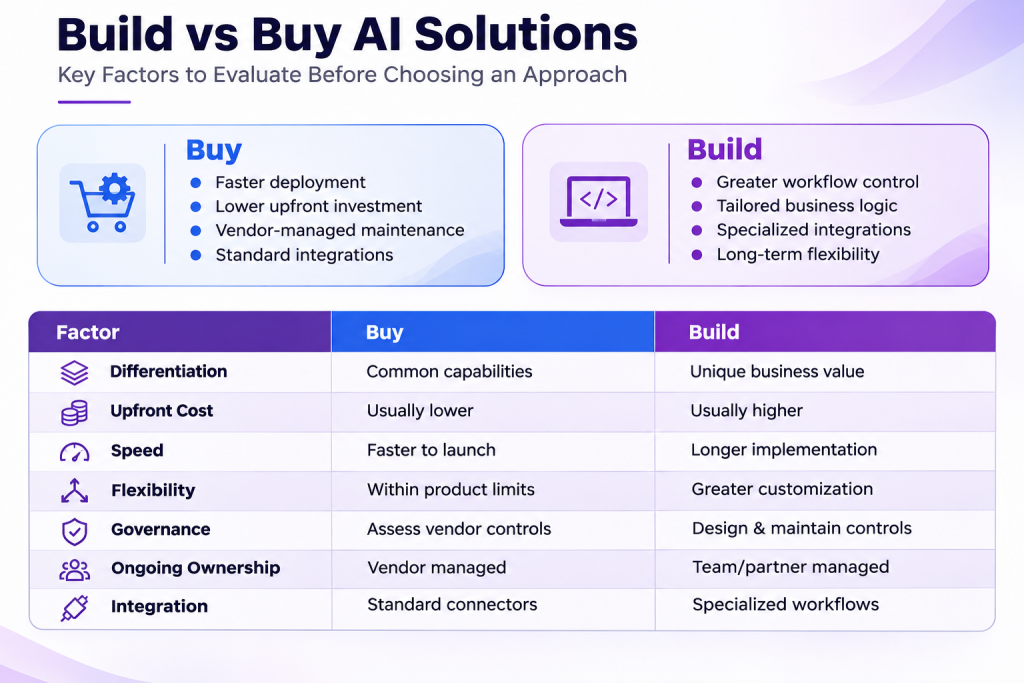
Evaluate total cost, including integration, training, usage, monitoring, support, and future changes. The lowest upfront price may not deliver the strongest return.
Making the Right Choice for Long-Term AI Success
Successful build vs buy AI solutions decisions start with business objectives, not technology preferences. The goal is to choose an approach that delivers value today while adapting to future business needs and growth priorities.
Considering whether to build, buy, or combine AI capabilities? Explore AI for custom software development as one option for creating tailored solutions that align with specific business requirements.
Futurism AI can help evaluate business needs, integration complexity, governance requirements, and long-term scalability to identify the approach best suited to your goals.
FAQs
Is it cheaper to build or buy AI solutions?
Neither is always cheaper. Buying often reduces upfront development costs, while building adds engineering and maintenance expenses. The right choice of buying or building an AI solution depends on integration, usage, support, and long-term business value.
How do organizations choose custom AI versus off-the-shelf platforms?
Start with the use case. In a custom AI vs off the shelf evaluation, compare differentiation, data requirements, integration complexity, speed, governance, and internal skills. Choose the simplest option that meets requirements reliably.
When does building AI make sense?
Build when AI depends on proprietary knowledge, specialized workflows, or a distinctive customer experience, and the expected value justifies long-term ownership.
What are the risks of buying AI software?
A product may not fit every workflow or integration need. Effective AI software selection requires reviewing data handling, vendor controls, usage costs, portability, and exit options before committing.
Can organizations combine build and buy approaches?
Yes. Buy common capabilities and customize selected workflows using proprietary data, integrations, and business rules. Evaluate each use case separately.
TRENDING POSTS
-
NLP in 2026: Trends, Challenges, and Real-World Impacts Shaping Global Business
-
How Agentic AI Improves Enterprise Workflows without Replacing Teams
-
Is Agentic AI Safe for Enterprises? Governance, Risk Controls and Real-World Deployment
-
Agentic AI vs Automation: What Enterprise Leaders Need to Know
-
Agentic AI for Enterprises: Use Cases, Architecture and Adoption Strategy